
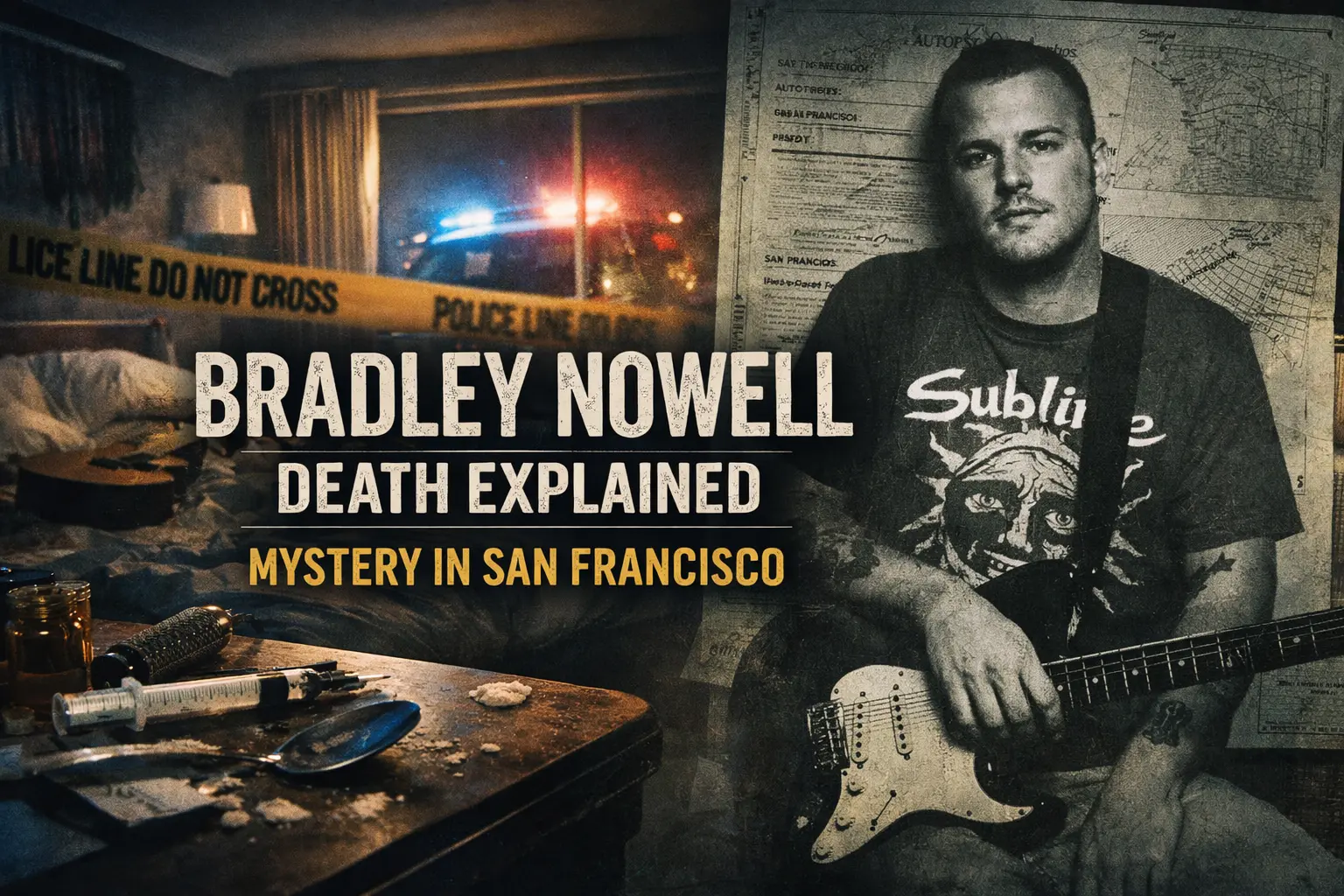
Nearly three decades later, people are still searching: Bradley Nowell death explained.
Not because the official cause is unknown. It isn’t.
But because the story behind it feels unfinished.
On May 25, 1996, the lead singer of Sublime was found unresponsive in a San Francisco motel room. He was 28 years old. Authorities ruled the death an accidental heroin overdose. The case closed quickly.
And yet, for fans and those who followed the band’s rise, the loss never felt simple. The timing was devastating. Success was finally within reach. A new album was ready. A tour was underway.
The facts are clear. The emotions are not.
Victim Background
Bradley Nowell was born on February 22, 1968, in Long Beach, California. In 1988, he co-founded Sublime, a group that blended ska, punk, reggae, and hip-hop into something unmistakably its own.
The band built a loyal underground following in the early 1990s. Their music carried humor, chaos, vulnerability — and often, honesty about addiction.
Nowell’s struggle with heroin was not hidden. It surfaced in interviews, in performances, and in lyrics. Friends and bandmates were aware of relapses and attempts at sobriety. The battle was ongoing.
In 1995, he married Troy Dendekker. The couple had a son that same year. By 1996, Sublime stood on the edge of mainstream recognition. The self-titled album that would define their legacy had just been completed.
The momentum was real. So were the pressures.
Chronological Timeline
Early Addiction Struggles
Throughout the early 1990s, Bradley Nowell’s heroin use moved in cycles. There were periods of sobriety. There were relapses. Touring and recording were sometimes disrupted.
Addiction is rarely linear. For Nowell, it was part of daily life — even as his career accelerated.
May 1996: A Turning Point
In May 1996, Sublime was preparing for a tour. The self-titled album was finished but had not yet reached the level of commercial success it would later achieve.
On May 24, 1996, the band performed in Petaluma, California. After the show, they traveled to San Francisco.
It was just another stop on the road. Nothing outwardly dramatic.
May 25, 1996: The Morning
The next morning, Bradley Nowell was found unresponsive in his motel room in San Francisco.
Emergency responders were called. He was pronounced dead at the scene.
He was 28 years old.
Almost immediately, his name became linked in popular conversation to the idea of the “27 Club,” though he was technically a year older. The symbolism stuck anyway — another young musician gone too soon.
Investigation and Evidence
The official cause of death was determined to be a heroin overdose.
Authorities found no signs of foul play. The death was treated as accidental from the outset. An autopsy was conducted, and toxicology results confirmed the presence of heroin consistent with overdose.
There were no public indications of third-party involvement. No evidence suggesting homicide.
Because the manner of death was ruled accidental, the investigation was brief. The case did not evolve into a criminal inquiry.
For law enforcement, the explanation was medically straightforward.
For fans, it was emotionally harder to process.
When a case closes quickly, it can feel abrupt — even if the facts are clear.
Suspect Analysis
There were no suspects.
Law enforcement did not pursue any individuals in connection with Bradley Nowell’s death. The ruling of accidental overdose ended the matter legally.
Still, in the court of public opinion, conversations took on a different tone.
Some questioned whether those around him could have intervened more forcefully. Others wondered whether the pressures of touring contributed to relapse. There were broader reflections on how addiction was handled within the music industry at the time.
These are not allegations of crime. They are reflections on responsibility — personal, cultural, systemic.
The available evidence supports the official ruling: accidental overdose. Nothing more.
Trial or Current Status
There was no trial.
The case was officially closed in 1996.
Shortly after his death, Sublime’s self-titled album was released. It became the band’s breakthrough. Songs like “Santeria” and “What I Got” gained widespread radio airplay.
Commercial success arrived almost immediately — but Bradley Nowell was not there to witness it.
In the years that followed, the surviving members of Sublime continued performing under variations of the band’s name, navigating legal and branding issues along the way. Through it all, Nowell’s voice remained central to the band’s identity.
His presence lingered in recordings, even as he was physically absent.
Unanswered Questions
When people search “bradley nowell death explained,” they often want more than a medical answer.
Was the relapse sudden?
Public accounts acknowledge cycles of sobriety and relapse. It is not fully documented how long Nowell had been sober prior to his death. What addiction specialists consistently note, however, is that relapse after a period of sobriety carries increased overdose risk due to lowered tolerance.
What happened in the hours before?
Reports confirm he was alone when found in his motel room. Beyond that, the detailed sequence of events leading up to his final moments has not been extensively documented publicly.
Could it have been prevented?
That question lingers in nearly every overdose case. Touring stress, sudden career shifts, and personal pressures can intensify vulnerability. But whether intervention would have changed the outcome is unknowable.
The facts explain the cause. They do not erase the sense of loss.
Social and Legal Impact
Bradley Nowell’s death became part of a broader narrative about addiction in the music world.
In the 1990s, heroin use was not uncommon in certain rock scenes. The cultural framing of substance abuse often blurred into mythology. Losses were mourned — but sometimes also romanticized.
Nowell’s death added to a growing list of musicians lost to overdoses. It highlighted the dangers of relapse and the fragile space between recovery and risk.
Over time, conversations around addiction evolved. Public awareness expanded. Discussions shifted more toward treatment, recovery, and harm reduction.
There were no direct legal reforms tied specifically to his death. But culturally, it contributed to a larger reckoning within the industry.
Reflective Conclusion
So what does “bradley nowell death explained” truly mean?
It means acknowledging the official facts: On May 25, 1996, in San Francisco, Bradley Nowell died of a heroin overdose. Authorities ruled it accidental. There was no criminal case.
It also means recognizing the human story behind those facts.
He was a husband. A father. A musician on the verge of mainstream breakthrough. A man navigating addiction while standing at the edge of fame.
The dispute in this case is not about forensic evidence. It is about interpretation. Some see inevitability. Others see preventable tragedy. Many see the harsh realities of addiction colliding with sudden success.
What remains is the music — still played, still sung, still discovered by new generations.
Bradley Nowell’s voice did not disappear in 1996.
But the questions — quiet, complicated, unresolved — continue to echo.
FAQ
-
What was the official cause of Bradley Nowell’s death?
According to official reports, Bradley Nowell died from a heroin overdose on May 25, 1996, in San Francisco. Authorities ruled the manner of death accidental. When readers search for bradley nowell death explained, this confirmed overdose is the central finding referenced in public records.
-
Where did Bradley Nowell die?
Bradley Nowell was found unresponsive in a motel room in San Francisco, California. Emergency responders pronounced him dead at the scene on May 25, 1996. The location is a key detail often included in discussions about bradley nowell death explained.
-
How old was Bradley Nowell when he died?
Bradley Nowell was 28 years old at the time of his death. Although sometimes associated in pop culture with the “27 Club,” he had already turned 28 in February 1996.
-
Was foul play suspected in Bradley Nowell’s death?
No. Authorities found no evidence of foul play. The death was investigated and officially ruled an accidental heroin overdose. There were no suspects, and the case did not proceed as a criminal investigation.
-
Was Bradley Nowell struggling with addiction before his death?
Yes. Publicly available information confirms that Bradley Nowell had a history of heroin addiction, including periods of sobriety and relapse. This background is often referenced when discussing bradley nowell death explained.
-
Did Bradley Nowell see the success of Sublime’s breakthrough album?
No. Sublime’s self-titled album was released shortly after his death in 1996. The album achieved major commercial success posthumously, meaning Bradley Nowell did not witness its widespread impact.