When people search philip fraser disappearance explained, they’re looking for something simple—an answer, a turning point, a moment where confusion becomes clarity.
But this story doesn’t offer that.
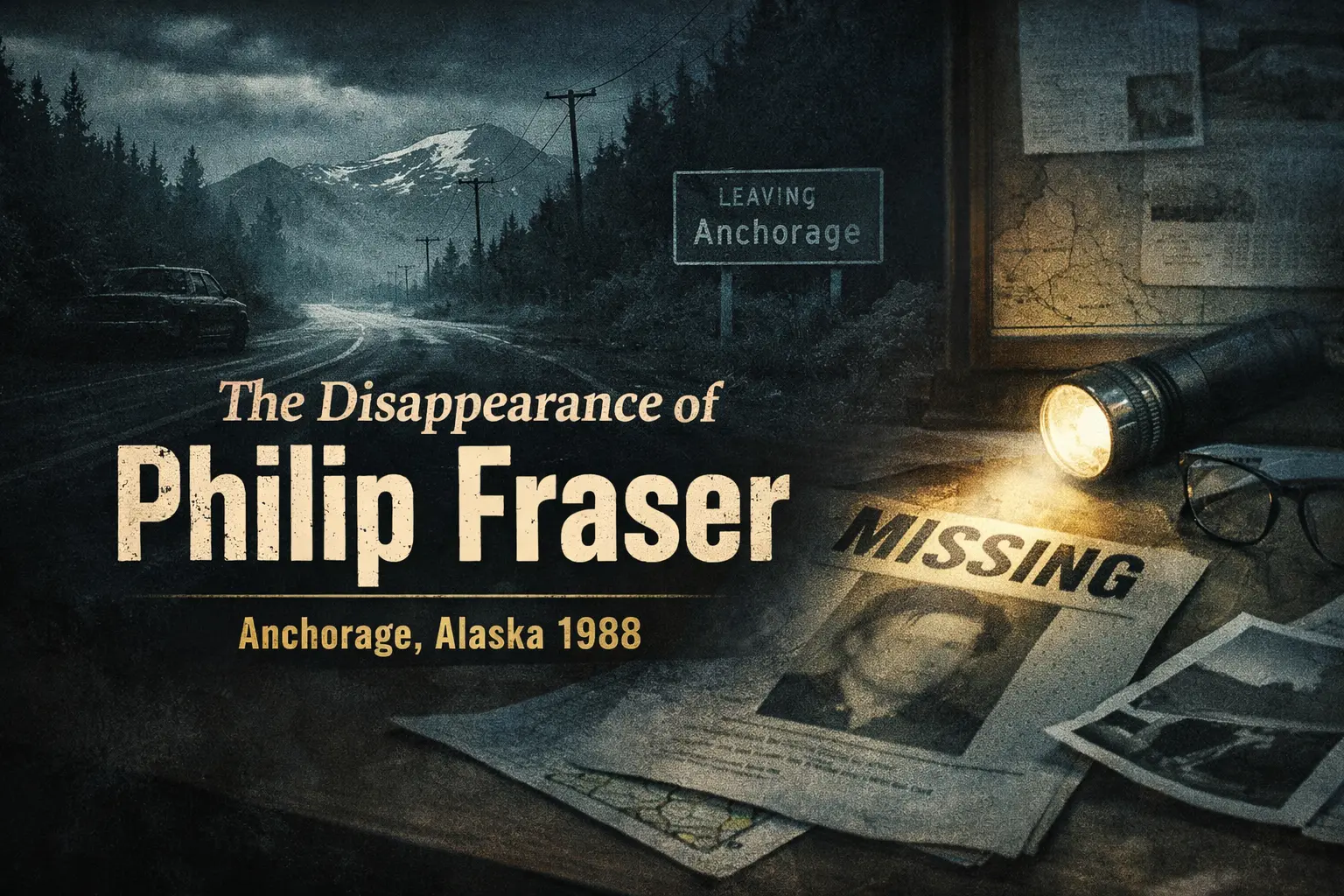
In 1988, Philip Fraser vanished in Anchorage, Alaska. No dramatic public confrontation. No widely documented crime scene. No clear explanation. Just a man who was there one day—and gone the next.
What followed wasn’t resolution. It was silence.
Who Was Philip Fraser?
Public information about Philip Fraser is limited. What exists comes primarily from missing person records and later summaries of the case.
He was living in Anchorage at the time he disappeared. Alaska in the late 1980s was growing, shifting, expanding. Anchorage offered opportunity, but it also carried isolation. Beyond the city limits, vast stretches of wilderness could swallow a person whole without leaving a trace.
There is no verified public evidence suggesting Fraser intended to leave his life behind. No confirmed plans to relocate. No established pattern of preparing for a sudden departure.
By all available accounts, his disappearance was unexpected.
And when something happens without warning, it leaves people searching for meaning.
The Last Known Moments
Philip Fraser was last seen in Anchorage in 1988. The precise circumstances of that final confirmed sighting have not been widely detailed in public records.
There was no documented emergency call tied directly to his disappearance. No publicly confirmed altercation.
Then contact stopped.
He didn’t return home. He didn’t reach out in any confirmed way to friends or family. There were no public records of travel plans or formal notifications suggesting he had chosen to leave.
He simply vanished from the record.
The Days After
In missing person cases, the first days matter most.
It isn’t publicly clear how quickly a formal report was filed. In the 1980s, investigative tools were far more limited than they are today. There were no digital databases linking jurisdictions instantly. No cell phone tracking. No modern surveillance networks.
If early searches were conducted, the full scope of those efforts has not been extensively documented in accessible public sources.
What is known is this: there was no immediate breakthrough.
No confirmed discovery of his belongings tied to a crime.
No publicized recovery of a vehicle connected to a suspicious scene.
No body.
The absence of evidence began to define the case itself.
The Investigation
Anchorage authorities treated Philip Fraser’s disappearance as a missing person investigation. Public reporting does not clearly state whether foul play was suspected from the outset.
When adults disappear, investigators must first determine whether the absence is voluntary. Legally, adults are allowed to leave without notice. That reality can complicate and sometimes slow investigations.
There has been no publicly confirmed crime scene connected to Fraser’s disappearance.
No widely documented forensic evidence.
No publicly released physical proof linking his case to a specific suspect or criminal act.
Over time, the case became part of Alaska’s larger collection of unresolved disappearances.
A Cold Case in Alaska
Alaska presents unique investigative challenges.
The terrain is vast. Weather conditions can be extreme. Remote areas are difficult to search thoroughly, especially in the late 1980s when technology was limited.
Many Anchorage cold cases from that era share similar obstacles:
- Forensic science was less advanced.
- Evidence preservation standards differed from today’s protocols.
- Witness memories fade.
- Time erodes details.
Without confirmed remains or decisive forensic findings, Philip Fraser’s case remains unresolved.
Were There Suspects?
One of the most frustrating elements of the Philip Fraser Alaska cold case is what hasn’t happened.
There have been no public announcements identifying a primary suspect. No widely documented arrests directly tied to his disappearance.
That doesn’t mean investigators dismissed the possibility of foul play. It simply means no publicly known case strong enough for prosecution has emerged.
In long-term missing adult investigations, authorities typically consider several possibilities:
- Voluntary disappearance
- Accidental death, particularly in remote terrain
- Foul play by an unknown individual
Publicly available information does not confirm which scenario applies to Fraser.
Community discussions over the years have included speculation. But speculation is not evidence. And in cases like this, that distinction matters deeply.
No Trial, No Resolution
There has been no public trial connected to Philip Fraser’s disappearance.
No convictions.
No formal charges that led to courtroom proceedings.
As of the latest available public information, he remains listed as a missing person.
The case stands unsolved.
Law enforcement agencies sometimes revisit cold cases, especially when new forensic techniques become available. It has not been widely publicized whether preserved evidence exists in Fraser’s case—or whether it has undergone modern testing.
In many cases from the 1980s, advances in DNA analysis decades later have produced unexpected answers. Whether that will happen here remains unknown.
The Questions That Linger
Did he leave voluntarily?
If so, there would typically be signs—financial activity, documented relocation, confirmed sightings. No publicly verified evidence shows that Philip Fraser established a new life under his own identity.
Was foul play involved?
There is no confirmed crime scene. No publicly disclosed forensic evidence of violence. Yet the absence of a body does not eliminate the possibility of homicide.
Alaska’s environment complicates everything. Wilderness can conceal accidents. It can conceal crimes.
Were early investigative opportunities missed?
It’s impossible to know. In 1988, there were no smartphones, no GPS trails, no digital footprints. Surveillance cameras were not widespread. Information moved more slowly.
Would modern tools have changed the outcome? That question can’t be answered.
A Broader Pattern
Philip Fraser’s disappearance exists within a larger context.
Alaska consistently reports high missing persons rates compared to other U.S. states. Geography plays a significant role. So does isolation.
When someone disappears in Anchorage, the search area can quickly expand beyond city streets into terrain that is difficult to access and even harder to search comprehensively.
There’s also a historical reality: missing adult cases have often received less sustained media attention than cases involving children. Media coverage influences public awareness, tips, and resource allocation.
Fraser’s case never became a national headline. That limited exposure may have affected the number of leads generated.
The Human Cost
There’s a term psychologists use for situations like this: ambiguous loss.
It describes the pain of not knowing.
There is no confirmation of death.
No proof of survival.
No final chapter.
Families and loved ones are left suspended between hope and grief, unable to fully mourn, unable to fully move on.
Cold cases carry weight for investigators as well. Each unsolved file represents a story without resolution, a person whose final moments remain unclear.
Philip Fraser’s disappearance is not just an investigative puzzle. It is a human absence.
Where Things Stand
Based on publicly available information, Philip Fraser’s case remains open and unsolved.
There have been no widely reported breakthroughs.
No confirmed recovery of remains tied to him.
No suspect brought to trial.
Time makes solving cases harder—but not impossible. Forensic science continues to evolve. Cold cases across the country have been reopened and resolved decades later through DNA testing and modern analysis.
Whether those advancements will one day clarify what happened in Anchorage in 1988 is uncertain.
Looking Back
People search philip fraser disappearance explained because they want structure. They want a timeline that leads somewhere. They want certainty.
But some cases resist that.
Philip Fraser walked through Anchorage in 1988 and then, at some point, he disappeared from the known record. No confirmed crime. No confirmed accident. No verified voluntary departure.
Just a gap.
And until new evidence emerges, that gap remains—quiet, unresolved, and still waiting for answers.
FAQ
-
What is the Philip Fraser disappearance explained case about?
The philip fraser disappearance explained case refers to the 1988 disappearance of Philip Fraser in Anchorage, Alaska. He was last seen that year, and no confirmed evidence has publicly clarified whether his disappearance was voluntary, accidental, or the result of foul play. The case remains unsolved.
-
When did Philip Fraser go missing?
Philip Fraser was last seen in 1988 in Anchorage, Alaska. Publicly available records confirm the year but provide limited detail about the exact circumstances of his final confirmed sighting.
-
Where was Philip Fraser last seen?
Philip Fraser was last seen in Anchorage, Alaska. Specific publicly documented details about the exact location of his last sighting have not been widely released.
-
Has anyone been charged in Philip Fraser’s disappearance?
No. There have been no public arrests, charges, or trials connected to Philip Fraser’s disappearance. The case remains open and unsolved based on available information.
-
Was foul play confirmed in the Philip Fraser case?
There is no publicly confirmed evidence establishing foul play. Investigators have not publicly identified a suspect or disclosed forensic findings that conclusively explain what happened.
-
Is the Philip Fraser case still open today?
Yes. Based on available public records, the philip fraser disappearance explained case remains unresolved. There have been no widely reported breakthroughs, and Philip Fraser is still listed as a missing person.