Table of Contents
Background of Alonzo Brooks
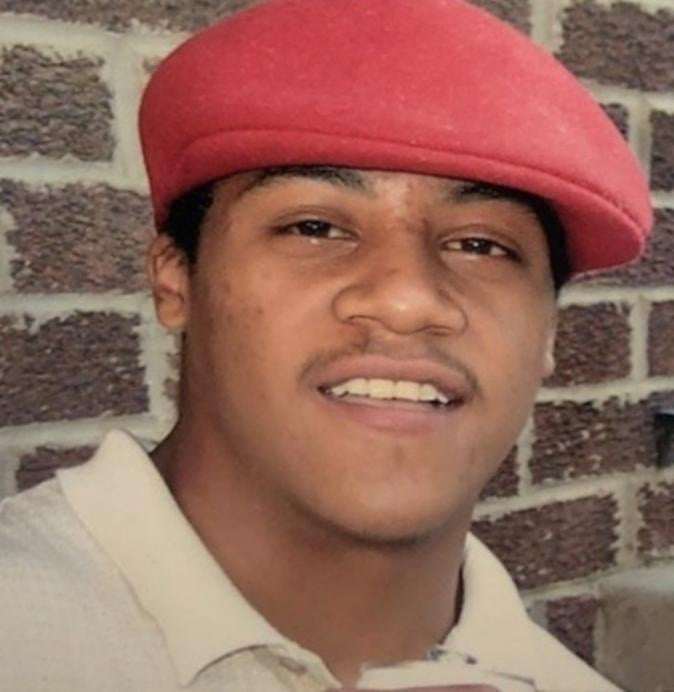
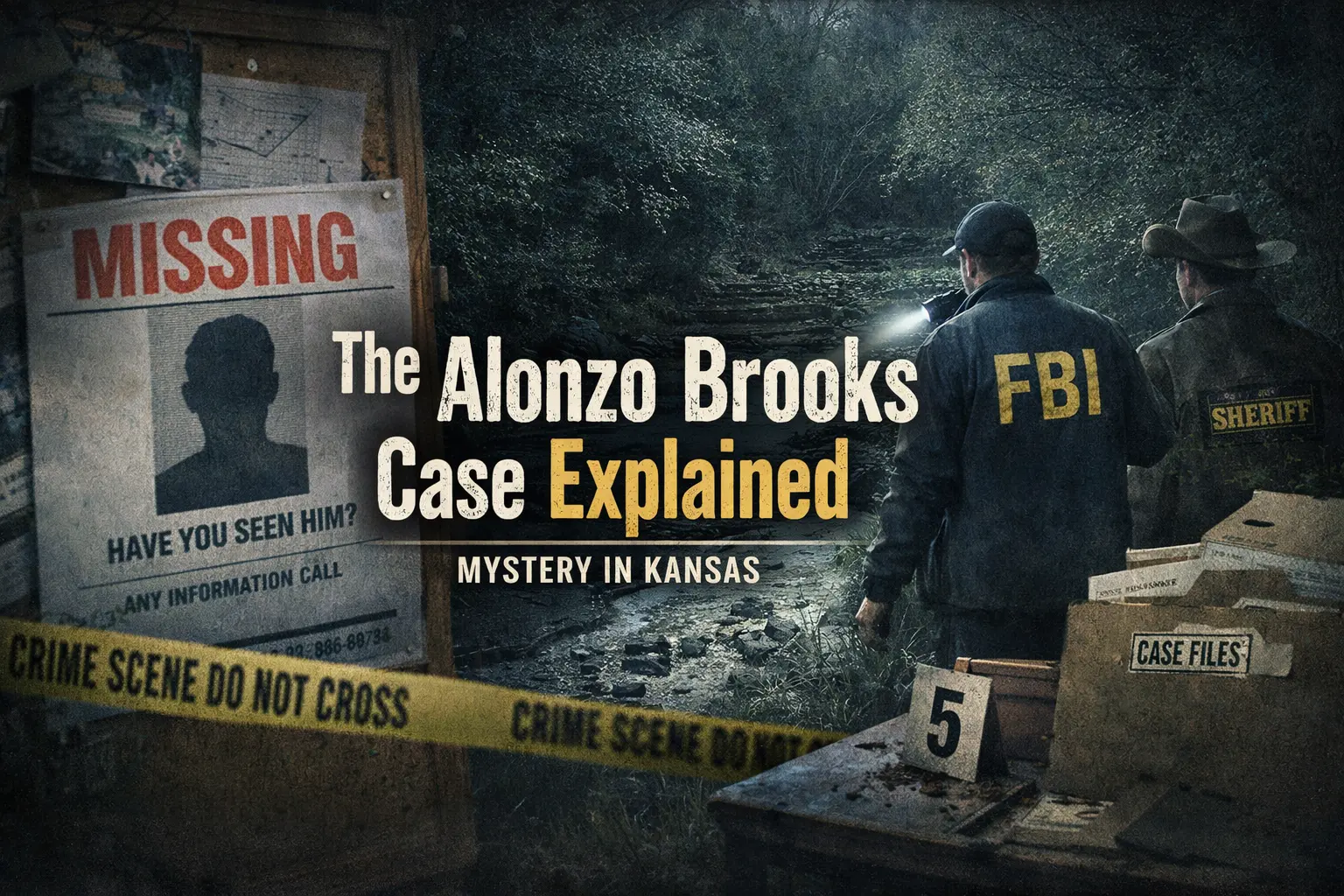
Alonzo Tyree Brooks was 23 in 2004 – the youngest of five siblings in a tight-knit Kansas family[25][1]. He grew up in Topeka and later lived in nearby Gardner, working as a custodian. Family members remember Alonzo as playful and good-natured; his sister described him as the kid who “followed us everywhere” and always had a joke[25]. Everyone in his family knew him as the type who preferred sleeping in his own bed, rather than out at a party[26].
Brooks had a mixed heritage: his father was Black and his mother Hispanic[8], and he was often the only African-American person in his social circle. According to official descriptions, he was “mild-mannered” and “good-humored”[27]. On April 3, 2004, he left home to meet three friends and go to a rural house party on the outskirts of the town of La Cygne, roughly 50 miles south of Gardner[1]. Little did he know that this night would be the last time anyone saw him alive.
After Brooks disappeared, his family and friends struggled with both grief and frustration. His aunt and siblings became his spokespeople, keeping Alonzo’s name in the news. His mother, Maria Ramirez, and others have repeatedly appealed for justice, even establishing a Facebook page to gather information. For them, Alonzo’s personality and future were tragically cut short – a promising young man with a caring family who became a symbol of unresolved injustice.
Timeline of Events
- April 3, 2004: Alonzo attends a large house party just outside La Cygne, Kansas[1]. The gathering was loud and crowded (around 100 people), and Brooks – one of only three Black men present – became the target of racial slurs according to some witnesses[2][10]. Late that night, his three friends all left the party separately, apparently under a misunderstanding. Each thought someone else would give Alonzo a ride home, but all departed, leaving him stranded without a ride[17].
- Early April 4, 2004: When Alonzo fails to return home by midday, his family becomes worried. According to his sister, Alonzo’s mother immediately calls his friends and learns the address of the farmhouse party from the friend who drove him there[12]. She contacts the Linn County Sheriff’s Department to report him missing.
- April 4–11, 2004: Over the next few days, the Sheriff’s Department leads a search for Brooks. With assistance from the Kansas Bureau of Investigation and the FBI[8], law enforcement combs the area around the farmhouse and along Middle Creek. They look near the barn, fields, and along the creek banks. However, they find nothing. Rainfall at the time (later noted by investigators) likely raised the creek and covered debris, meaning Alonzo’s body, if there, was hidden under waterlogged brush[19]. The search team winds down without discovering any trace.
- May 1, 2004: Nearly four weeks after he vanished, a volunteer search is organized by Alonzo’s family and friends. About 50 people fan out along the two branches of Middle Creek near the party house[1]. Shockingly quickly – in under an hour – they find Alonzo’s body lodged partially on top of a pile of brush in the creek[18]. The location is scarcely a mile from the farmhouse, just where law enforcement had searched.
- May 2004: Brooks’s body is taken to the Sedgwick County coroner’s office. On May 2, 2004, officials examine the body and report no clear cause of death. There are no broken bones or signs of major injury, and nothing in his lungs indicates drowning[23]. The pathologist rules the cause undetermined[3]. The family is devastated by this lack of answers, but they bury Alonzo in Topeka.
- 2004–2018: The case goes cold. With no leads or cause of death, no arrests are made and investigations do not yield results. The FBI’s Violent Criminal Apprehension Program (ViCAP) logs the case but there is little activity. For 15 years, the Brooks family holds onto hope as authorities periodically tell them the case remains open.
- November 16, 2020: Netflix’s Unsolved Mysteries (season 15, episode 4) posts a public update on Twitter. The official account announces the FBI has learned of a second house party in La Cygne on the night Alonzo disappeared. It says that after a fight broke out at that other party, people walked to the farmhouse where Alonzo was last seen[6]. The FBI urges anyone who attended either party to come forward. This new information about a second location had not been part of the 2004 case files, suggesting witnesses at that other gathering may hold important clues.
- June 11, 2020: (Announcement) The U.S. Attorney’s Office for Kansas and the FBI publicly reopen Brooks’s case after 16 years. They announce a \$100,000 reward for information leading to an arrest[13][20]. U.S. Attorney Stephen McAllister states that investigators have reviewed all evidence, re-interviewed witnesses, and are treating the death as suspicious[20][3].
- July 2020: The FBI exhumed Brooks’s remains from Mount Calvary Cemetery in Topeka[5]. They send the body to the Armed Forces Medical Examiner at Dover AFB, Delaware, for a new autopsy. Modern forensic anthropologists carefully examine bones, tissue, and even insect activity from the original site.
- April 5, 2021: The Armed Forces Medical Examiner’s report is released. Officials announce that Brooks’s death is a homicide[13][11]. Specifically, experts found “injuries… inconsistent with normal patterns of decomposition,” meaning Alonzo was not killed by accident[21]. U.S. Attorney Duston Slinkard declares “it was no accident. Alonzo Brooks was killed”[11]. This reclassification is the first official confirmation that foul play caused Brooks’s death.
- 2021–Present: The FBI and U.S. Attorney’s Office say the case remains a priority. No suspects have been arrested. The \$100,000 reward is still on the table[13][15]. Federal agents continue to solicit tips and interview anyone who might shed light. In interviews, the lead FBI agent Leena Ramana notes that many partygoers were teenagers in 2004 and might speak now that they are adults[28]. The Brooks family and law enforcement plead with the public to break the code of silence for any chance at justice.
Investigation Breakdown
In April 2004, once Alonzo was reported missing, the Linn County Sheriff’s Department led the effort. Sheriff’s deputies combed the farmland around the party location under the big oak trees and in nearby ditches, but weather conditions worked against them: rain had swollen Middle Creek, likely hiding anything caught in its currents. The sheriff’s office enlisted help from the Kansas Bureau of Investigation (KBI)[8]. Local television reports at the time mention sheriff’s divers and search dogs, though the body remained elusive. By mid-April, unable to find Alonzo, officials had to suspend the search, assuming he might still be alive somewhere.
The 2004 autopsy was performed without a clear lead on what to look for. Investigators told the coroner there was no sign of trauma; given the month-long delay before discovery, the coroner found nothing definitive[3]. With no apparent wounds, and with the high waters noted, the examiners could not classify it a homicide. The results “did not determine a cause of death,” according to the U.S. Attorney[3]. At that point, law enforcement did not name any suspects, and no one was charged. The local case file simply listed Brooks as missing; once found, the case went into limbo as an unexplained death.
Over the next decade and a half, federal authorities largely did not intervene. The FBI’s profiling unit (ViCAP) listed the case in its database, but there was no active FBI investigative report in the public record. The Brooks family periodically contacted the sheriff for updates, but at best were told it remained unsolved with few new leads.
In 2019, new leadership changed course. Stephen McAllister became U.S. Attorney for Kansas and pushed for re-examination of old cases. He directed federal agents to reopen Alonzo Brooks’s file[13]. The FBI assigned Special Agent Leena Ramana to lead the re-investigation. Ramana’s team meticulously revisited every 2004 step: they re-interviewed dozens of original witnesses and also tracked down people who had not been questioned. Agents questioned local residents, neighbors, and even people who might have seen vehicles near the creek that night. In news conferences, prosecutors have said they “collected all available physical and forensic evidence” from 2004[20], which implies revisiting any items stored (though what was preserved is unclear).
Meanwhile, criminal analysts and forensics experts conducted a new review. The body exhumation in July 2020 allowed specialists (including the Armed Forces forensic team) to study injuries, which had not been apparent in 2004 due to decomposition. The FBI and Justice Dept. gave no detailed report on the specific findings (to protect the investigation), but they publicly confirmed these experts concluded the death was a homicide[11]. The investigators note in an FBI press release that Brooks had been “killed”[11]. This also indicates that authorities now consider the partygoers as possible suspects, especially in a hate-crime context.
Throughout 2020–2023, the FBI has conducted an intensive follow-up. According to press statements, agents reviewed the original crime scene photos and even consulted an entomologist on the insects found on the body[21]. They also retraced the search routes by discussing it with family searchers and analyzing historical weather data (to explain why cops missed the body)[19]. On a community level, investigators re-opened public appeals, working with media to re-release flyers and feature the case on shows like Dateline NBC and Unsolved Mysteries. They emphasize that modern tips or technologies (even the possibility of DNA on old evidence) could still break the case.
In summary, the investigation can be seen in two phases: the 2004 local probe, which ended without identifying a cause or suspect; and the 2019–present federal probe, which brought new resources and a redefined strategy. Key players now include the FBI Kansas City Field Office and the U.S. Attorney’s Office for the District of Kansas. Kansas City FBI Special Agent Leena Ramana and Assistant U.S. Attorney Duston Slinkard (later replaced by McAllister) have been the public faces of the renewed efforts. Their offices continue to coordinate with Linn County authorities and the KBI, hoping that crowd-sourced tips will finally point to the truth.
Evidence & Controversies
Physical Evidence: The chief physical evidence is the body itself and the creek bank where it was found. In 2004, authorities noted Alonzo’s clothes were intact and there were no signs he had drowned (no water in lungs)[23]. The body was partially embedded in debris; the FBI later theorized that rising water may have hidden him until returning water levels revealed him[19]. Because the body was exposed to the elements for weeks, forensic clues (like fingerprints or clean wounds) were minimal. Investigators did recover any personal items that might have been near him (cell phone, wallet – none were reported found), limiting leads.
Forensic Analysis: The new forensic examinations discovered anomalies. Investigators say experts found wounds or fractures not consistent with decay[21], but details are classified. They determined the death was homicidal[11]. The controversy is that while the conclusion is public, how he died is still secret. Family and public only know “someone killed him,” not whether by stabbing, beating, etc. This secrecy, though standard in an open homicide, frustrates those seeking closure.
Witness Accounts: Almost every person present at the 2004 party has given some account, yet their stories conflict or leave questions. One major controversy is that no one has taken responsibility or even provided a coherent story of Alonzo’s final moments. Some attendees reportedly mentioned Alonzo had words with a white girl at the party[10], or that a brawl involving racist taunts might have occurred[10]. Others said Alonzo disappeared quietly. The FBI noted “no one who attended the party would admit to knowing what happened to him”[18]. This unanimity of silence itself is controversial: did attendees collude in silence? Or simply nobody saw anything? The family believes someone must know but fear either retribution or community pressure.
Social and Racial Tensions: The case has fueled debate about race and justice in small-town America. Alonzo’s family and supporters argue that if he’d been white, authorities might have pursued his disappearance more aggressively or sooner. They highlight reports that “racial slurs were directed at him” during the party[10] as evidence of possible motive. Critics point out that until 2020, there was little overt acknowledgment of a racial motive from law enforcement. The fact that the FBI only recently classified it as a potential hate crime[2] is taken by some as evidence that institutional bias delayed investigation vigor.
Media Attention: Coverage by Netflix, Dateline, newspapers and podcasts has been double-edged. It brings new witnesses forward and forces official action, but also stirs sensational speculation. Producers have titled some segments “Hate Crime” and emphasized the racial angle. Family members say this media narrative has drawn national sympathy, but local suspects complain it prejudices opinion. Law enforcement tries to walk a line: they confirm racism is being investigated[2] but stress they will follow only provable leads.
Rainfall and Environment: A minor controversy among armchair sleuths is the role of weather. Did rain simply hide Alonzo’s body from searchers? The FBI noted that heavy creek flow could bury a body under brush[19]. Some skeptics say this excuse sounds convenient — why did family members spot the body so quickly if police searched thoroughly? Law enforcement counters that a dry brush pile isn’t obvious until water clears out debris. The truth is likely a combination of factors (weather, search techniques), but public distrust remains about how the initial search failed.
Theories
Note: The following theories are drawn from witness reports and media accounts, and remain unproven.
- Racially-Motivated Murder: The leading theory, now formally considered by investigators, is that Alonzo was killed by one or more partygoers because of his race. This theory is supported by accounts of racist remarks that night and the fact he was among the only Black attendees[2][10]. Under this hypothesis, some local told journalists they had seen white men antagonize Alonzo. If true, Alonzo might have been chased into the creek or attacked at the water’s edge. The FBI is actively exploring hate-crime statutes[2], meaning prosecutors may pursue civil rights charges if evidence surfaces.
- Flirtation/Fight Gone Wrong: Multiple sources mention that Alonzo may have been flirting with a white girl at the party[10]. One theory is that the girl had a jealous boyfriend or relative. Netflix’s coverage highlights a “mystery girl” who vanished that night, suggesting someone took offense. Producer Marcus Clarke said, “Was this somebody’s sister? Was this somebody’s girlfriend?” and noted how suspicious it was that none of Alonzo’s friends would talk about the girl[22]. Under this theory, an argument (or a misunderstanding) over the girl could have provoked an angry reaction from others, possibly culminating in Alonzo being forced into the creek. Friends of Alonzo have said they left him at the party, implying whatever happened occurred after the friends had gone home[12].
- Second Party Altercation: The FBI’s own tweet about a second party suggests another scenario. If Alonzo attended an earlier event where a fight happened, he might have walked (or been led) to the La Cygne farmhouse after that confrontation[6]. In this version, some partygoers left the first house, encountered a problem (perhaps involving Alonzo), and came to the second location. Investigators may consider whether Alonzo was injured at the first fight, then somehow ended up in the creek later that night. It’s also possible one group was leaving one party and bumped into another, creating a chaotic situation. The exact role of this second party is still being pieced together.
- Accidental Drowning (Natural Causes): An alternate hypothesis (largely discounted by officials) is that Alonzo fell into the creek by accident and drowned. Supporters of this idea point out that Alonzo’s breathing showed no water during the 2004 exam, which could mean he was already dead or missed. However, the reclassification to homicide undermines this theory. The latest autopsy described injuries incompatible with mere decomposition[11], implying he suffered trauma before death. No credible forensic opinion from Dover AFB has suggested accidental death.
- Suicide or Self-Harm: This theory is essentially dismissed by family and investigators. Alonzo was generally happy and had no known reason to hurt himself, and the circumstances (body on debris in creek) do not fit a suicide pattern. The coroner found no note or evidence of self-harm[3]. The FBI’s homicide ruling effectively rules out suicide as a cause.
- Cover-up by Partygoers: A more cynical theory suggests some attendees conspired to hide a murder or mishap. In this view, perhaps an accidental injury (during a fight or prank) occurred, panic set in, and people colluded to conceal it. The unbroken silence of 100 partygoers for years feeds this theory. It’s not a formal hypothesis from police, but it underlies the “everyone is hiding something” sentiment in news reports[9]. Investigators have publicly appealed to anyone who knows, implying they suspect at least one person present has key information[9].
Each of these theories remains speculative until investigators find concrete evidence or eyewitness testimony. What is certain is that Brooks’s death was not declared an accident – it is officially a murder[11]. The investigators’ decision to label it homicide means they believe a person or persons caused it intentionally. Theories will continue to be tested as new information (tips, forensic leads) comes in.
Current Case Status
As of 2025, the Alonzo Brooks case is still unsolved and under active FBI investigation. The FBI and U.S. Attorney’s Office have publicly reiterated their commitment. Acting U.S. Attorney Duston Slinkard (in 2021) said they “will spare no resources… to bring those responsible to justice”[11]. Special Agent Langan and Agent Ramana have emphasized that the case remains a priority, and they hope new witnesses – especially those who were too young or afraid to speak in 2004 – will now come forward[28].
The \$100,000 reward announced in 2020 is still on offer[13]. No one has claimed it yet: four years later “there is no indication anyone has provided ample information to claim it,” a local report noted[14]. All tip lines remain open – the FBI Kansas City office and the anonymous crimestoppers hotline are urging anyone with information to call or submit online[13].
No arrests have been announced, and no suspects have been publicly identified. Investigators have indicated that for now, all leads are being treated confidentially. They have not said whether they have specific suspects under scrutiny. However, they have reiterated that someone at those parties must know something: “the code of silence must be broken,” as the U.S. Attorney put it[20].
For the Brooks family, the case is “still a priority,” as they say, especially as birthdays and holidays bring fresh grief. Father and mother have both passed away since 2020, but Alonzo’s sister and aunt continue to advocate. They accompany authorities on search efforts and media interviews, insisting they won’t give up[15][29].
In practical terms, the case remains open-ended: – The FBI classification is homicide, but with no murder charges filed yet[11]. – Investigators continue to analyze any physical evidence they can find (for example, rechecking Alonzo’s cell phone records or re-questioning people newly connected to the 2004 parties). – Technology is changing: cold-case teams often use genetic genealogy or advanced lab tests that didn’t exist in 2004. There have been no public reports of DNA hits or such, but it remains a possibility. – If the case does go to trial in the future, it would likely be in federal court, perhaps under hate-crime charges if race is confirmed as a motive.
Where things stand now: A federal liaison describes it as “a homicide under investigation.” The reward and media attention indicate authorities have not given up. But no clear resolution is in sight. It is treated much like a missing person turned murder: still unresolved, but alive in the criminal justice system.
Broader Impact and Lessons
The Alonzo Brooks case has resonated beyond Kansas. It spotlights issues of racial tension, criminal justice in rural America, and the power of media in cold cases. Family members and advocates have said that nationwide attention (on NBC’s Dateline, Netflix’s Unsolved Mysteries, NPR and local news) has kept the case alive. As one of Alonzo’s investigators noted, if not for the new era of national scrutiny and the Black Lives Matter movement highlighting racial crimes, “Alonzo was just another Black man who had died or disappeared” like many others in forgotten cases[30].
From a law enforcement perspective, this case underscores the importance of search diligence and persistence. In background news coverage, the U.S. Attorney stood by the river where Alonzo’s body was found and reflected on the “quiet place of profound sadness” with no answers[9]. The lesson is that investigators see silent witnesses all around us and hope public conscience will compel one to speak up.
Additionally, the case illustrates how modern forensic science can rewrite history. The re-examination at Dover AFB, using techniques unavailable in 2004, turned a presumed accident into a confirmed murder[2]. This has implications for other unsolved deaths: families of victims who once got “undetermined” autopsies now see hope in requesting re-tests.
On a societal level, Alonzo’s story has become a cautionary tale about community dynamics. Locals have openly called for neighbors to “tell us what happened” now that the kids are adults[31]. There’s a broad message encouraging communities to support the truth rather than silence it.
Lastly, there’s a lesson in accountability: even small jurisdictions can be held to federal standards if civil rights are at stake. The shift to a federal hate-crime investigation means higher scrutiny. Other communities may view this as precedent: an unresolved death, especially of a minority, can attract FBI attention years later.
In sum, the Alonzo Brooks case is not just about one victim; it reflects larger themes of how we investigate missing people, how racial context can affect a case, and how determined families and modern advocates can push an old mystery into the light.
Frequently Asked Questions (FAQ)
Q: Who was Alonzo Brooks and what happened to him?
A: Alonzo Tyree Brooks was a 23-year-old African-American man from Kansas. On April 3, 2004 he attended a rural house party near La Cygne, Kansas. He did not return home from that party, and his body was later found on May 1, 2004 in a nearby creek[1]. Initial autopsy found no cause of death[3], but a new autopsy in 2021 classified it as a homicide[11].
Q: Why did it take so long to solve Alonzo Brooks’s case?
A: After Alonzo’s disappearance, the local sheriff’s department searched the area but did not find him[18]. His family’s search found the body a month later. The 2004 coroner could not determine how he died[3], so the investigation went cold. The case sat unsolved for 15 years until FBI and federal prosecutors reopened it in 2019[13] with a \$100,000 reward[20]. Advances in forensics then showed evidence of murder[11].
Q: What does the latest autopsy say about his death?
A: The exhumed body underwent a new autopsy by the Armed Forces Medical Examiner in 2021. The examiners reported “injuries… inconsistent with normal decomposition,” meaning it could not have been a simple accident[21]. Acting U.S. Attorney Duston Slinkard stated that this proved Alonzo “was killed” and not a victim of nature[11]. Officials are treating his death as a homicide investigation.
Q: Is the FBI involved and what are they doing?
A: Yes. The FBI Kansas City office, along with the U.S. Attorney’s Office for Kansas, took over the case in 2019[13]. They have reviewed old evidence, re-interviewed witnesses from the party, and collected any remaining physical evidence. They issued a \$100,000 reward in June 2020[13] to encourage tips. In July 2020 they exhumed the body for a new autopsy[5]. Lead agent Leena Ramana has publicly announced the case remains open and asked for the public’s help in finding out what happened.
Q: Why do investigators think race was a factor?
A: Investigators note that Brooks was one of only three African-American men at the largely white party[2]. Witness rumors mention racial slurs and resentment directed at him that night[10]. Because of this context, the FBI is actively investigating Brooks’s death as a possible racially motivated crime[2]. The family and officials believe that if someone used racial epithets against him, it could indicate hate as a motive.
Q: What is the current status of the case?
A: The case remains an open federal investigation with no arrests made yet. A \$100,000 reward for information is still being offered[13]. Authorities continue to seek tips; no new public details have emerged after the 2021 homicide ruling. The FBI and U.S. Attorney’s Office say they will not stop until those responsible are identified[11]. As of now, the official stance is that Alonzo Brooks’s death is a homicide under investigation.
Sources
- FBI, “Alonzo Brooks” – Wanted Page, FBI Kansas City (case details and timeline)[1].
- FBI, “New Autopsy Determines Death of Alonzo Brooks was a Homicide” (press release, April 5, 2021)[2][18].
- U.S. Department of Justice, District of Kansas, “U.S. Attorney, FBI Announce $100,000 Reward in Cold Case” (press release, June 11, 2020)[3][9].
- KCTV5 News (Kansas City), Betsy Webster, “KC Unsolved: 2004 Kansas hate crime murder remains unsolved despite $100,000 reward” (Nov. 13, 2024)[4][32].
- KSHB Kansas City (Scripps News), Andrés Gutierrez & Kari Williams, “2004 death of Kansas man … ruled a homicide” (Nov. 2021)[11].
- KCUR 89.3 (NPR Kansas City), Luke X. Martin, “The FBI ruled this 17-year cold case in Kansas a homicide, but still no answers” (Oct. 13, 2021)[5][33].
- RadioTimes, Lauren Morris, “Unsolved Mysteries gives update on Alonzo Brooks case” (Nov. 17, 2020)[6][22].
- FBI, “Alonzo Brooks” – Seeking Information poster, FBI Kansas City (official summary)[1].
[2] [13] [16] [17] [18] New Autopsy Determines Death of Alonzo Brooks was a Homicide — FBI
[3] [9] [20] District of Kansas | U.S. Attorney, FBI Announce $100,000 Reward in Cold Case | United States Department of Justice
[4] [8] [10] [12] [14] [15] [19] [21] [24] [25] [28] [31] [32] KC Unsolved: 2004 Kansas hate crime murder remains unsolved despite $100,000 reward
[5] [7] [29] [30] [33] The FBI ruled this 17-year cold case in Kansas a homicide, but still no answers for Alonzo Brooks’ family | KCUR – Kansas City news and NPR
[6] [22] Alonzo Brooks case update revealed by Unsolved Mysteries | Radio Times
[11] [26] 2004 death of Kansas man Alonzo Brooks ruled a homicide