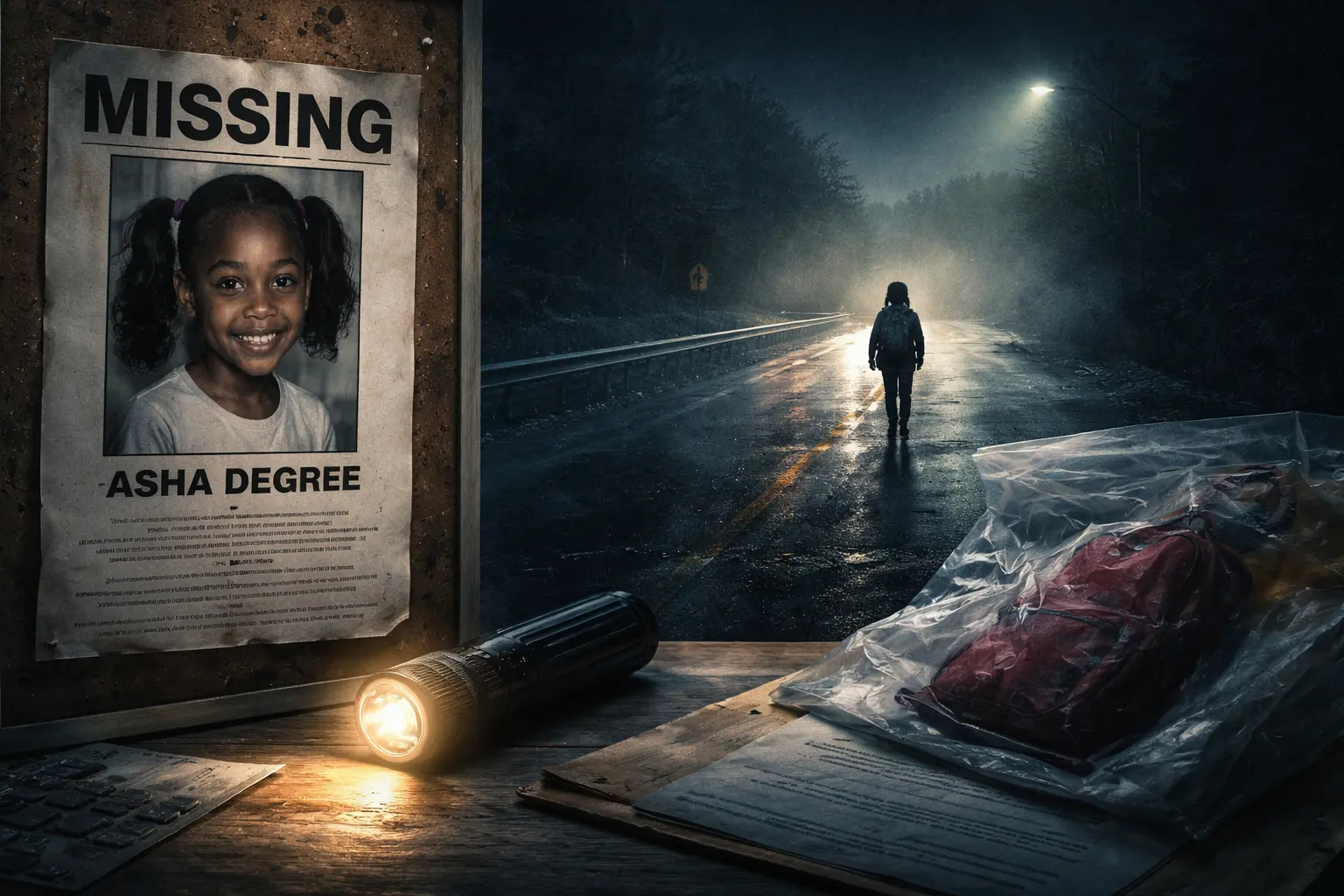
People search asha degree disappearance explained hoping for closure — a neat ending, a final answer. What they find instead is a story suspended in time. A 9-year-old girl walked out of her home before dawn on Valentine’s Day in 2000, was seen alone on a storm-dark highway, and then disappeared.
There was no confirmed struggle.
No known abduction scene.
No clear suspect.
Only fragments remain: a handful of sightings, a buried backpack, and a family that has lived more than two decades inside unanswered questions.
The reason this case lingers in the public mind is simple. It contradicts instinct. Children do not quietly step into the night without a reason. And when they do, investigators usually uncover a trail that explains why. Here, the trail exists — but it fades just as it begins to form.
Who was Asha Degree?
Asha Degree was a fourth-grade student living in Shelby, North Carolina, with her parents and older brother. Public accounts describe her as shy, careful, and strongly connected to her family. She attended school, participated in church, and followed a structured daily routine.
There is no evidence she was a habitual runaway.
There is no public record suggesting violence in her home.
There is no indication she had ever disappeared before.
Her family has consistently said she had no reason to leave voluntarily. Law enforcement has never publicly disputed that. That agreement between investigators and family is rare in missing child cases and adds weight to the mystery.
From a psychological perspective, the absence of warning signs is striking. Many disappearances follow visible stress: escalating conflict, secrecy, or outside influence. In Asha’s case, public reporting has never revealed a clear precursor. Either the signs were invisible — or they never existed.
That silence is one of the case’s most troubling features.
The timeline: a child walking into a storm
The night of February 13–14, 2000
A storm moved through the area that night, knocking out power temporarily. After electricity returned, the household settled into sleep. By every available account, the evening felt ordinary.
At some point after midnight, Asha packed a backpack. The exact list of items has never been fully released, but investigators confirmed it contained clothing and personal belongings. She left the house quietly, without waking anyone.
The exact moment she walked out remains uncertain. That missing timestamp complicates every reconstruction. Even small gaps matter in investigations like this, and this gap is measured in hours.
Early morning sightings
Between roughly 3:30 and 4:00 a.m., motorists traveling along Highway 18 reported seeing a small child walking alone. The description matched Asha.
One driver became concerned and turned around to check on her. According to public investigative summaries, when the vehicle approached, the child ran from the roadside into nearby woods. The reaction suggests fear, but fear of what remains unknown.
Was she afraid of strangers?
Was she determined not to be stopped?
Was she already committed to reaching somewhere specific?
No confirmed explanation has emerged.
Morning discovery
Around 6:30 a.m., Asha’s parents realized she was missing and contacted emergency services. The response was immediate. Within hours, the situation escalated into a major search effort.
Volunteers, tracking dogs, and helicopters covered the area. The storm that passed earlier may have erased physical traces. Rain can scatter scent, flatten footprints, and wash away fragile evidence.
Despite the scale of the search, nothing definitive was found that day.
Investigation and physical evidence
The early search
Authorities treated the case as urgent from the beginning. The FBI joined local agencies. Search teams focused on the highway corridor and wooded areas tied to the reported sightings.
Tracking dogs reportedly traced Asha’s scent from her home toward the highway, supporting the belief that she left on foot. After that point, the trail stopped.
That sudden end suggests a turning point. Either environmental conditions destroyed evidence, or she entered a vehicle. Investigators have never publicly confirmed which scenario they believe is more likely.
The backpack discovery
More than a year later, in 2001, construction workers in Burke County uncovered a plastic-wrapped backpack buried near a roadway. Authorities confirmed it belonged to Asha.
The wrapping appeared intentional. Investigators stated publicly that the bag looked deliberately concealed. It was not discarded casually; it had been preserved.
Inside were items not fully explained in public reporting, including objects not known to belong to her. Law enforcement has withheld certain details, likely to protect investigative value. That silence suggests the contents may hold evidentiary importance.
The backpack expanded the case geographically. It implied that Asha traveled — or was transported — far beyond the last known sighting. Yet even this discovery did not trigger an arrest.
No public DNA breakthrough was announced.
No timeline was finalized.
No suspect was named.
The backpack remains one of the case’s most haunting pieces of evidence.
Suspect analysis
No one has been publicly charged in connection with Asha’s disappearance.
Investigators have repeatedly stated they believe someone possesses critical information. Their appeals over the years point toward human involvement after she left home, though the specifics remain undisclosed.
Several theories appear in public discussion, not as conclusions, but as analytical possibilities.
Grooming or luring
Some experts suggest Asha may have trusted someone who persuaded her to leave. Children rarely embark on dangerous journeys alone without a perceived purpose. If she believed she was meeting someone safe, that could explain her calm preparation.
There is no confirmed evidence of secret communication, but investigators have never ruled out outside influence.
Opportunistic encounter
Another scenario proposes that she encountered danger after leaving home. A lone child on a highway before dawn is vulnerable. A passing motorist could have intervened under the guise of help — or with criminal intent.
This theory explains the sudden disappearance, but not the original decision to leave.
Planned meeting interrupted
A third possibility blends the first two. She may have intended to reach a destination but was intercepted before arriving. The buried backpack could represent an attempt to hide evidence after the fact.
None of these scenarios has been confirmed publicly. They remain frameworks for understanding a case still missing its central truth.
Current status of the case
The case remains open.
Law enforcement continues to request tips and revisit evidence. Advances in forensic technology have solved decades-old cases across the country, and officials have stated they continue to evaluate materials using modern methods.
There is no confirmed suspect.
No verified sighting after the highway encounter.
No official explanation of what happened next.
Asha’s family continues public advocacy. Their message centers on remembrance, dignity, and the belief that answers still exist.
Unanswered questions
This case endures because its core questions remain untouched by time.
Why did a cautious child leave home voluntarily during a storm?
Did she expect to meet someone?
Why run from a concerned motorist?
Who buried the backpack — and for what purpose?
Was the concealment meant to hide evidence permanently, or temporarily?
What happened in the space between the roadside sighting and the burial site?
Investigators have never provided public answers that close these gaps. Each detail opens another layer of uncertainty. In missing child cases, understanding motive is often as critical as identifying a suspect. Here, motive is the most elusive piece.
Social and legal impact
Asha’s disappearance reshaped conversations about child safety in her region and beyond. Early public reactions to missing child cases often assume voluntary runaway behavior. This case complicated that narrative.
It demonstrated how quietly a child can vanish.
It underscored the danger of nighttime isolation.
It revealed how weather can erase crucial evidence in the first hours.
The case has also been cited in advocacy for cold case funding and forensic investment. Families of missing children frequently point to Asha’s story as proof that time should not diminish investigative commitment.
Time does not erase responsibility. It increases it.
A reflection on silence and memory
The search phrase asha degree disappearance explained suggests a conclusion waiting to be read. What exists instead is a portrait of absence — a space where facts stop and hope continues.
Somewhere between a quiet bedroom and a rain-dark highway, a child stepped into a mystery that still resists resolution.
Her case is not sustained by speculation. It survives because people refuse to forget her. Investigators revisit evidence. Her family keeps her name alive. The file remains open.
And in that openness lives a fragile possibility:
That one memory, one withheld detail, one overlooked fragment could connect the pieces at last.
Until that day, Asha’s disappearance remains a living question — and behind that question stands a family still waiting for the truth.
FAQ
-
What is the Asha Degree disappearance explained in simple terms?
The asha degree disappearance explained refers to the 2000 case in which 9-year-old Asha Degree left her home in Shelby, North Carolina, before dawn and was later seen walking along a highway. Despite immediate searches and a long investigation, she was never found. The case remains open, and authorities still request tips from the public.
-
When did Asha Degree go missing?
Asha Degree disappeared in the early morning hours of February 14, 2000. She left her family home sometime after midnight during a storm. Motorists reported seeing a child matching her description walking along Highway 18 a few hours later. These sightings are the last confirmed public timeline points in the asha degree disappearance explained.
-
Was Asha Degree ever found?
No. Asha Degree has never been located. In 2001, her backpack was discovered buried in another county, wrapped in plastic. Authorities confirmed it belonged to her, but the discovery did not lead to an arrest. The backpack remains one of the most important pieces of evidence in the asha degree disappearance explained.
-
Did police identify any suspects in the case?
Law enforcement has never publicly named or charged a suspect. Officials have stated they believe someone knows more than they have shared, but no confirmed suspect has been announced. The investigation remains active, and certain evidence details are withheld to protect the integrity of the asha degree disappearance explained.
-
Why is the Asha Degree case considered unusual?
The case is unusual because Asha appeared to leave home voluntarily despite being described as cautious and closely connected to her family. There were no public signs of forced entry or struggle. Investigators confirmed sightings of her walking alone at night, which makes the asha degree disappearance explained especially difficult to interpret.
-
Is the Asha Degree case still being investigated today?
Yes. The case is still open. Authorities continue to review evidence and encourage new tips. Advances in forensic technology have revived other cold cases, and investigators have indicated they continue examining materials using modern methods. The asha degree disappearance explained remains an active missing child investigation.