The desert on the edge of Albuquerque looks endless. Wind smooths the sand. Sounds travel and disappear. For years, that open stretch of land kept a secret large enough to shake an entire city.
The west mesa bone collector case explained is often described as a serial murder mystery. But it is also a story about absence — about women who vanished quietly, families who kept searching, and a system that didn’t connect the dots in time. Eleven women disappeared over several years. Their names circulated in small circles. Their families waited for calls that never came.
Then, in 2009, the ground gave up what it had been hiding.
The discovery didn’t just reveal a killer. It exposed a chain of missed opportunities, fragile communication, and painful questions about which lives receive urgency and which are allowed to drift into the margins.
The Women Before They Became Victims
Before the headlines grouped them together, each woman had her own complicated life. They were daughters and mothers. Some were trying to rebuild. Some were surviving day to day. Public records show that many faced addiction or were involved in sex work — realities that shaped how their disappearances were perceived.
Between roughly 2001 and 2005, they went missing one by one.
Families reported them. Flyers were printed. Calls were made to hospitals, jails, shelters. In some cases, reports were delayed. In others, leads were thin from the start. Because the women moved through high-risk environments, their absences were sometimes assumed to be temporary or voluntary.
For their loved ones, nothing felt voluntary about it.
Years passed in uncertainty. Hope narrowed but never disappeared. The women remained missing, suspended between rumor and silence.
Timeline: The Years That Slipped Away
Early 2000s: Disappearances Without Connection
From 2001 to 2005, multiple women connected to Albuquerque’s street economy vanished. At the time, the cases were treated individually. No confirmed link united them. Each file sat in its own lane, separated by paperwork and jurisdiction.
Only later would the similarities appear unmistakable.
February 2009: A Bone in the Sand
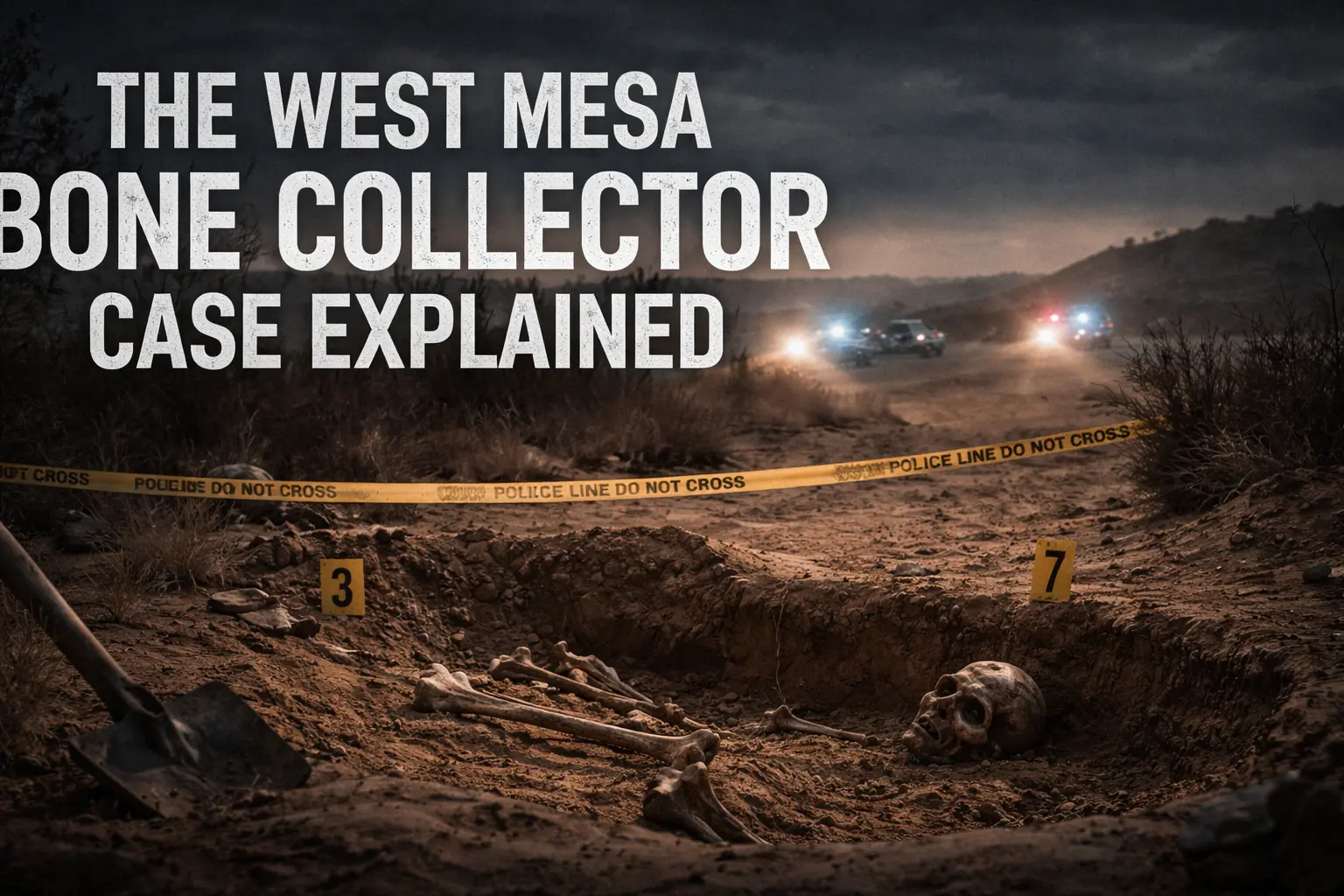
In 2009, a woman walking her dog noticed what looked like a human bone protruding from the desert. Authorities arrived expecting a single recovery. Excavation quickly turned into something far larger.
Investigators uncovered multiple sets of remains buried in shallow graves. The site expanded into one of the largest homicide scenes in New Mexico history. Ultimately, the remains of 11 women were recovered.
Scattered missing persons cases suddenly converged into a single, devastating narrative.
2009–2010: Names Returned to Families
Through forensic identification, the women were named. Families who had waited years for answers received confirmation that their loved ones had been murdered. Closure, if it came at all, arrived wrapped in grief.
Media coverage intensified. The west mesa burial site mystery drew national attention. Task forces formed. Leads stretched across state lines. Tip lines flooded.
But despite the scale of the response, no arrest followed.
Investigation and Evidence
The crime scene itself fought back. Years in the desert had eroded critical evidence. Heat, wind, and time degrade everything. Forensic teams worked carefully, but nature had already taken its toll.
Authorities collected clothing fragments, personal effects, and trace materials. Public statements confirm the existence of DNA evidence, though detailed findings have never been released. Much of the case file remains sealed to protect the integrity of the investigation.
One of the most persistent criticisms surrounding the west mesa murders investigation failure focuses on coordination. Families and advocates argue that earlier connections between the disappearances might have triggered a unified response sooner. Law enforcement has pointed to the challenges of managing multiple agencies and limited resources.
Witness testimony presented another obstacle. Many potential witnesses lived in unstable conditions where cooperation with police was inconsistent. Fear, mistrust, and mobility complicated interviews.
The investigation accumulated fragments — suggestive but incomplete. Enough to indicate a pattern. Not enough to end it.
Suspect Analysis
Over time, investigators examined several persons of interest. Known violent offenders in the region were scrutinized. Search warrants were carried out. Properties were searched. Tips arrived from across the country.
No one has been charged.
Authorities have maintained that while individuals drew attention, the available evidence did not meet the threshold required for prosecution. In public cases, speculation grows quickly, but official statements have remained cautious. Naming suspects prematurely could jeopardize any future case.
That caution has not eased frustration. Families worry that time has erased opportunities. Some observers believe the killer may have died, relocated, or been incarcerated under another identity.
Without an arrest, every theory remains suspended.
Current Status: Officially Open, Emotionally Frozen
The west mesa cold case update is stark in its simplicity: the case is still open.
Cold case investigators continue to review evidence. Advances in DNA technology offer a measure of guarded optimism. Authorities periodically reexamine preserved materials using updated forensic tools. Each scientific improvement carries the possibility — however small — of a breakthrough.
Families refuse to let the case disappear. Memorials, advocacy campaigns, and public remembrance events keep the women visible. Their persistence has preserved attention long after the media cycle moved on.
On paper, the investigation is active. In reality, it exists in a state of waiting — poised for a development that has yet to come.
Unanswered Questions That Won’t Fade
Why weren’t the disappearances linked sooner?
This question sits at the center of discussions about west mesa investigation mistakes. Critics point to systemic bias against marginalized victims. Law enforcement has acknowledged the difficulty of connecting cases across agencies while defending the work that was done.
Did one person commit all the murders?
Authorities have never publicly confirmed whether they believe a single offender was responsible. The burial site suggests planning and familiarity with the terrain, but without a suspect, behavioral conclusions remain uncertain.
Could there be more victims?
The desert is vast. Some fear the burial site may not tell the entire story. Officials have conducted searches in surrounding areas, but no public confirmation exists of additional discoveries.
Was the killer local?
Many analysts suspect local knowledge was involved. The location implies familiarity. Still, without an arrest, geographic profiling remains educated speculation rather than fact.
These unanswered questions shape the psychological core of the case. For families, uncertainty is not abstract — it is daily weight.
Social and Legal Impact
The case forced Albuquerque to confront uncomfortable realities about how missing persons cases are prioritized. Advocacy groups pushed for reforms in reporting procedures and communication between agencies.
It also sparked broader conversations about the vulnerability of women living in survival economies. The murders became part of a national dialogue about addiction services, housing instability, and the stigma attached to sex work.
Memorial projects emerged to restore individuality to the victims. Their names are spoken publicly, deliberately, to counter the anonymity imposed by the crime.
No legal resolution has arrived. Yet the social consequences remain visible. Discussions about cold case funding and victim advocacy frequently reference the West Mesa investigation as a warning about what can happen when systems fail to connect.
A Story That Refuses to End
The west mesa bone collector case explained does not offer closure. It offers persistence.
Evidence sits preserved in storage, waiting for the moment technology or chance rearranges it into meaning. Families carry memory and hope side by side, year after year. The desert remains unchanged on the surface, but its silence feels heavier now.
True crime often promises neat conclusions. This case resists that structure. It asks harder questions about attention, value, and the cost of delay. It reminds us that justice is not automatic. It must be pursued, protected, and demanded.
Until a name is spoken in a courtroom, the story remains unfinished.
And unfinished stories have a way of echoing.
FAQ
-
What is the West Mesa Bone Collector case explained in simple terms?
The west mesa bone collector case explained refers to the 2009 discovery of 11 murdered women buried on the West Mesa outside Albuquerque. The victims had disappeared between 2001 and 2005. Their cases were not connected until the burial site was found. Despite a large investigation, no suspect has been charged, and the case remains officially unsolved.
-
How were the West Mesa victims discovered?
The west mesa bone collector case explained began turning public in 2009 when a woman walking her dog found a human bone in the desert. Police excavation uncovered multiple shallow graves. Forensic work later identified 11 victims. The discovery linked several long-missing women to a single crime scene and triggered one of the largest homicide investigations in New Mexico history.
-
Who were the victims in the West Mesa case?
The west mesa bone collector case explained involves 11 women who came from vulnerable backgrounds, with several connected to addiction and street economies. Families had reported them missing years earlier. Identification through forensic analysis returned their names to the public record and confirmed they were homicide victims. Advocacy groups emphasize remembering them as individuals, not just as part of a serial case.
-
Why is the West Mesa investigation criticized?
The west mesa bone collector case explained is often cited in discussions about investigative gaps. Critics argue the disappearances were not linked quickly enough and that cases involving marginalized women received less urgency. Law enforcement has acknowledged the complexity of multi-agency coordination while maintaining the investigation remains active and evidence continues to be reviewed.
-
Are there any suspects in the West Mesa case?
Authorities have investigated multiple persons of interest in the west mesa bone collector case explained, including known violent offenders. However, officials state the available evidence has not met the legal standard required to file charges. No suspect has been publicly named, and the case remains open while forensic evidence continues to be reexamined.
-
Is the West Mesa case still being investigated today?
Yes. The west mesa bone collector case explained is still an active cold case. Investigators periodically revisit preserved evidence using newer forensic technologies, including advances in DNA analysis. Families continue to advocate for renewed attention, and law enforcement has stated the investigation has not been closed.