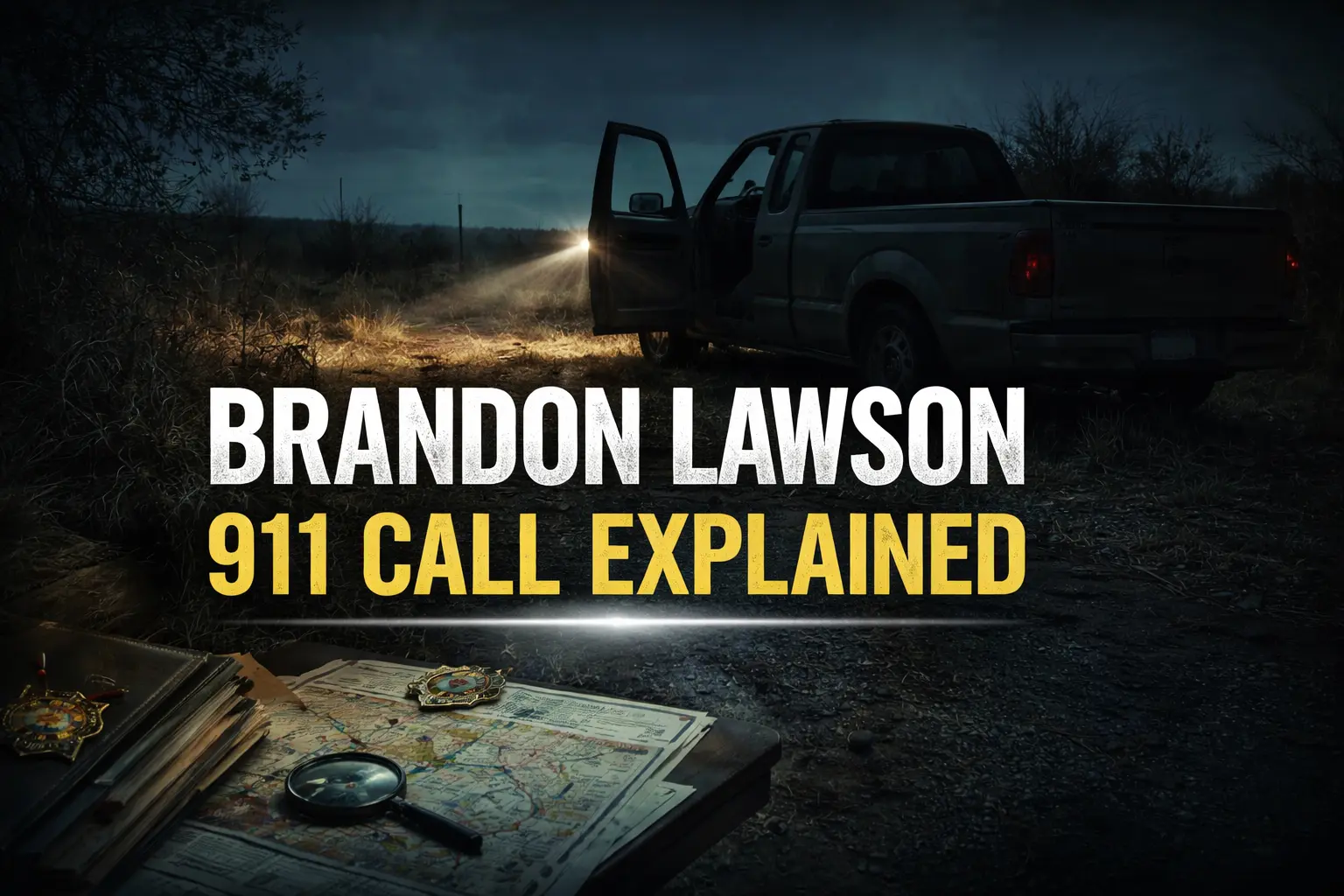
In the quiet hours of August 9, 2013, a frantic voice broke the rural night. It was Brandon Lawson—26, a father of four—speaking to 911 from a lonely stretch of West Texas. His words were frantic, fragmented, sometimes barely audible. He said he was being chased. He mentioned bleeding. Then the line went cold.
The recording of that call has been replayed, parsed, and argued over ever since. People listen for clues; they try to stitch sense from static. But for all the scrutiny, the call has offered more questions than answers. This is the story of Brandon Lawson: the man behind the voice, the night he disappeared, and the messy, human failures that followed.
Victim Background: Who Was Brandon Lawson?
Brandon lived in San Angelo, Texas. He was a son, a brother, and a devoted father to four children. Those who knew him describe someone rooted in family even while life felt complicated—strained relationships, financial pressure, personal struggles.
He had a history of substance use—something Brandon’s family never hid. But the people who loved him insist that he wasn’t violent and that leaving his children was not who he was. That portrait matters: it’s easy to let a headline erase the human details. Brandon was not a statistic; he was a person with ties, obligations, and people who counted on him.
Chronological Timeline: The Night Brandon Vanished
Late on August 8, 2013, after an argument with his girlfriend, Brandon left home. He drove south on U.S. Route 277 into a stark, remote part of Coke County—oil fields, mesquite, dark roads with little lighting.
Sometime after midnight his truck ran out of gas. He pulled over near Bronte. From there he called his brother, Kyle.
In that call, Brandon said something that would later fuel speculation: he told Kyle there were “Mexicans chasing him.” He sounded frightened and disoriented, but he could tell his brother roughly where he was. Kyle told him to stay put and drove out to find him.
Before Kyle reached the scene, Brandon called 911.
The 911 Call: What Was Said—and What Wasn’t
The 911 call lasts a little over 13 minutes. Much of it is hard to hear. Connection issues and background noise make parts of the recording difficult to decipher.
What is clear from transcripts and released audio:
- Brandon repeatedly said he was being chased.
- He referenced bleeding at one point.
- His speech was hurried and fragmented; panic threaded through his voice.
- The dispatcher had trouble confirming his exact location.
- At one point, he seemed to say, “Yes, I need the cops.”
- Eventually Brandon stopped responding and the call ended without a precise location.
The call became the center of the case—and in many ways, its sharpest puzzle. A frightened man asked for help. The help didn’t arrive in time to give him safety or — as it turned out — answers.
Investigation and Evidence: A Search Marked by Limits
Kyle arrived near Brandon’s truck while the 911 call was still on the line. He worked with the dispatcher to try to locate his brother but couldn’t find him.
When law enforcement reached the truck later, they found it abandoned. There were no obvious signs of a struggle, and no blood evidence that would match Brandon’s references on the call. Personal items that might suggest a planned disappearance were absent.
Search efforts followed: ground teams, volunteer parties, cadaver dogs, and aerial searches all scoured the area. But the landscape fought back—thick brush, uneven terrain, oil equipment scattered across private land. In some cases, search teams faced limited access because landowners initially denied entry.
Over time, those search efforts slowed and the area where Brandon was last known to be remained a gap—a narrow place between what was said on the phone and what could be physically found.
Suspect Analysis: Theories, Not Conclusions
No suspect was ever named. What emerged instead were theories—some plausible, others speculative—but none backed by direct evidence.
Accidental death. One idea is that Brandon became disoriented, wandered into brush, and succumbed to exposure or injury. Critics point out that extensive searches make that explanation feel incomplete; if he died close enough to the truck, why weren’t remains found sooner?
Psychological crisis. People who analyze the call have suggested Brandon may have been experiencing paranoia or hallucinations. That could explain his panic—but it doesn’t explain why no physical evidence surfaced for years.
Foul play. Rumors circulated online: cartel involvement, violent confrontation, foul play. Those theories were largely driven by the words Brandon used—his references to being chased—and by the human need for explanation. Law enforcement, however, has not produced evidence to substantiate those claims.
The uncomfortable truth is this: none of these theories are proven. They are attempts to fill a silence with narrative.
Trial or Current Status: Discovery and Partial Closure
A major development came nearly nine years later. In February 2022, human remains were found in a remote part of Coke County, less than a mile from where Brandon’s truck was abandoned.
For the Lawson family, that discovery changed the category of the case from “missing” to “found.” In early 2023, forensic testing confirmed the remains were Brandon’s.
But confirmation did not equal explanation. Authorities have not publicly released a cause of death. Investigators said there was no immediate evidence of foul play. The case is no longer treated as an active missing-person investigation, yet many feel it remains unresolved when it comes to the how and why.
Unanswered Questions That Still Haunt the Case
There are hard, short questions that linger:
- What did Brandon actually mean during the 911 call?
- Why wasn’t his location pinpointed when he was so close to the highway?
- How were remains missed for nearly nine years in an area that had been searched?
- Did assumptions about his mental state or substance history shape the initial response?
These aren’t conspiracy fodder. They’re gaps—places where communication, technology, and human judgment left space for doubt.
Social or Legal Impact
The case pushed conversation forward about how emergency calls are handled and how missing-person searches operate in rural America.
It raised concerns about:
- The quality of dispatching when callers are disoriented;
- The potential for bias when substance use is assumed;
- The problems of searching vast, privately owned terrain;
- The power of family advocacy to keep cases alive.
Brandon’s story became a cautionary example: how a single unclear call can spiral into decades of uncertainty, and how public narratives form quickly—sometimes faster than facts can catch up.
Reflective Conclusion: A Voice That Wasn’t Understood in Time
The 911 call made Brandon audible. It made his fear public. But it didn’t win him rescue.
This case is quieter than many true-crime dramas. There’s no neat antagonist. No courtroom. Just a messy intersection of human fear, imperfect systems, and the stubborn silence of the land.
For Brandon’s family, the identification of remains closed one chapter—but did not answer the most pressing question: what happened in those hours after the truck ran dry?
We keep listening to the recording because it feels like an unfinished conversation. We replay it because we want to understand the person behind the panic. And we return to the same, simple truth: a man called for help, and despite efforts, understanding didn’t come in time.
FAQ
-
What happened to Brandon Lawson?
Brandon Lawson disappeared after his truck ran out of gas near Bronte in Coke County, Texas, on the night of August 8–9, 2013. He called his brother and then 911; his abandoned truck was found, but he was missing. Human remains discovered in February 2022 were later forensically identified as Lawson in early 2023. Authorities have not publicly released a cause of death.
-
What does the Brandon Lawson 911 call explained tell us?
The recording shows a frightened, fragmented caller saying he was being chased and at one point mentioning bleeding. The dispatcher struggled to confirm his location. The call lasted over 13 minutes and ended without a precise location or a clear resolution. Analysts use the recording to study his mental state and timeline, but it did not by itself solve the case.
-
How long was the 911 call and what happened during it?
The public audio runs a little over 13 minutes. During the call Brandon speaks hurriedly, reports being chased, and at times is hard to understand due to connection and background noise. Dispatch repeatedly tries to get his exact location; the call ends with Brandon no longer responding.
-
Were any suspects ever charged in Brandon Lawson’s disappearance?
No. Law enforcement did not publicly name or charge any suspects related to his disappearance. Investigators carried out searches and later recovered remains, but no formal suspect or prosecution has been announced.
-
How were Brandon Lawson’s remains identified?
Remains found in February 2022 in remote Coke County were subjected to forensic testing. In early 2023 authorities confirmed through those tests that the remains belonged to Brandon Lawson. Public statements did not release a cause of death.
-
Is the Brandon Lawson case considered closed?
The missing-person phase effectively ended after the remains were identified, but authorities have not publicly released a cause of death or detailed findings. While it’s no longer an active missing-person search, public questions about how and why he died remain.