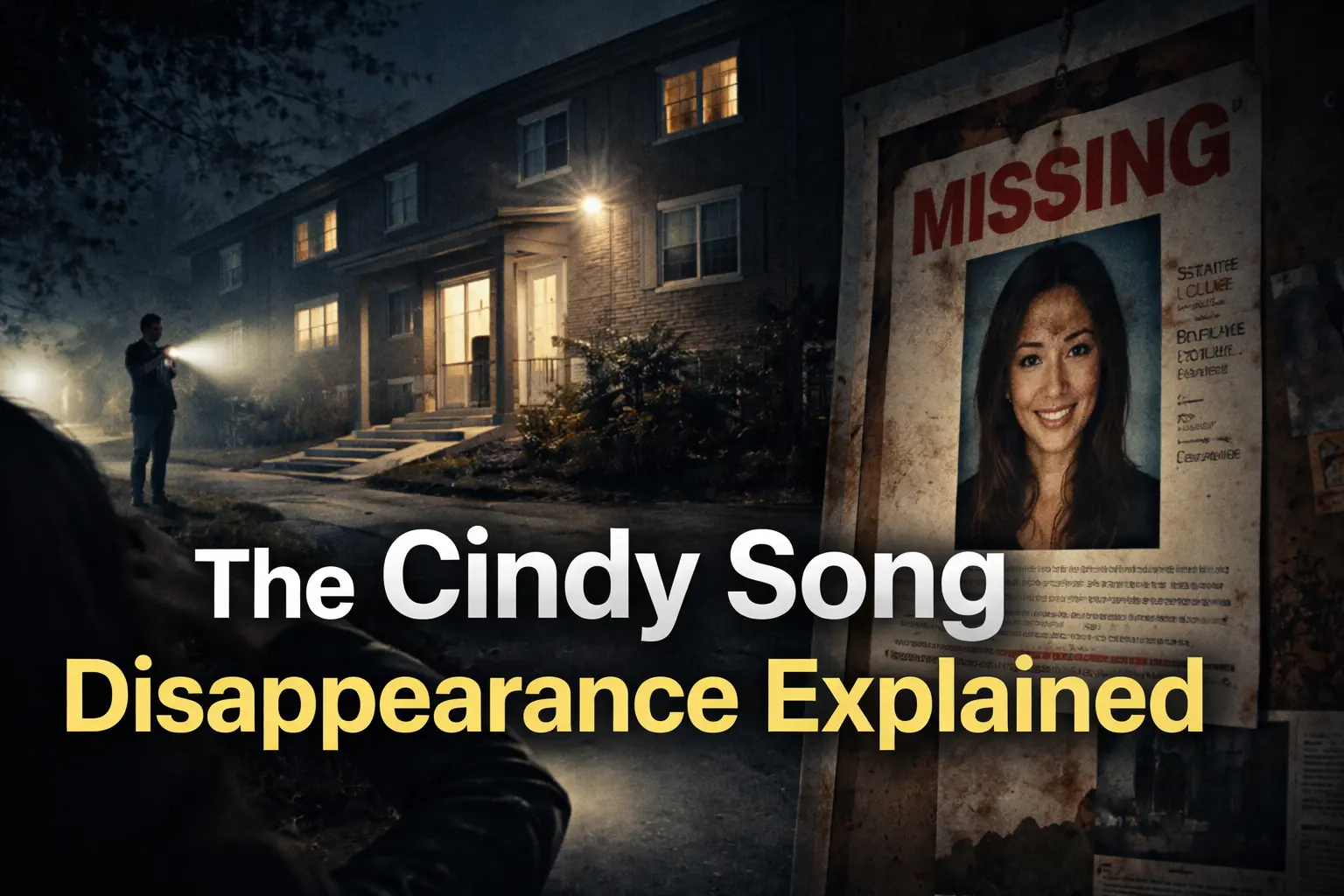
The morning after Halloween should have been ordinary. A college student sleeping late. A messy costume on the floor. Texts from friends replaying the night before.
Instead, Cindy Song’s apartment felt wrong.
Her purse was still inside. Her phone was there. Her car hadn’t moved. The door was unlocked. And Cindy — a 21-year-old Penn State student — was gone.
For more than two decades, people searching for answers still type the same phrase: “cindy song disappearance explained.” Not because it’s solved, but because it isn’t. The case lingers in that uneasy space where nothing is confirmed and every theory collapses under scrutiny.
There are no verified sightings after she walked into her apartment. No public forensic breakthrough. No arrest. Just a narrow window of time and the unsettling knowledge that someone vanished in a place that should have been safe.
Who Was Cindy Song?
Before she became a mystery, Cindy Song was simply a young woman building a future.
Born in South Korea, she immigrated to the United States with her family and grew up in Springfield, Virginia. By 2001, she was a student at Pennsylvania State University, studying integrative arts. Friends described her as outgoing, creative, and focused on her goals.
She had a busy social circle and the typical pressures of college life — classes, friendships, plans for what came next. Nothing publicly suggested she was in crisis. There were no known signs she wanted to disappear.
People close to her have consistently said the same thing: leaving voluntarily didn’t match who she was.
That disconnect — between her stable life and her sudden absence — is one of the reasons the case still feels so unresolved.
The Last Known Timeline
Halloween Night: October 31, 2001
Cindy went out with friends to celebrate Halloween in State College. She wore a bunny costume and moved through the familiar rhythm of a college party night. Witnesses later confirmed she had been drinking socially but did not appear unusually distressed.
In the early morning hours of November 1, a friend walked her back to her apartment complex. This moment anchors the timeline. It is the last widely accepted point where Cindy is known to be alive.
She was seen entering her apartment.
After that, everything becomes uncertain.
Morning of November 1
When Cindy didn’t answer calls or meet friends later that morning, concern escalated quickly. Friends went to her apartment and found a scene that didn’t make sense.
Her purse was inside. Personal belongings were untouched. The door was unlocked. Her car remained parked outside. There was no indication she had packed for a trip or even stepped out for errands.
She had disappeared without the items most people carry just to check the mail.
Authorities have not publicly detailed whether anything inside the apartment suggested a struggle. That absence of information has left a permanent gap in public understanding of what happened next.
From that point forward, the timeline goes dark.
Investigation and Evidence
Police treated Cindy’s disappearance as suspicious early in the investigation. The circumstances did not point to a planned exit.
Search efforts focused on interviews with friends, party attendees, and residents of the apartment complex. Investigators canvassed the area and issued public appeals, hoping someone had seen something small but critical.
Nothing solid emerged.
Digital and Physical Gaps
The year 2001 sits in an awkward technological era. Smartphones didn’t exist. Social media footprints were minimal. Security cameras were far less common than they are today.
Modern cases often generate a trail of digital breadcrumbs. Cindy’s did not. Investigators had to rely heavily on witness memory and physical searches, both of which fade quickly with time.
Tips came in over the years, but none led to a confirmed breakthrough. No publicly verified physical evidence has tied her to a location after she entered her apartment.
Public Appeals
Cindy’s family and community worked to keep attention on her case. Posters circulated. Her name moved through missing persons networks. Each wave of publicity reignited hope, but no definitive lead followed.
The case remains open.
Suspect Analysis
No one has been publicly charged in connection with Cindy Song’s disappearance. Theories exist, but none have crossed the threshold into prosecutable evidence.
Stranger Abduction
One possibility is that Cindy encountered someone after returning home. The unlocked door raises questions, but it doesn’t establish how or when she left the apartment.
There is no publicly confirmed forensic evidence linking a known offender to the scene.
Acquaintance Involvement
Statistically, many disappearances involve someone the victim knows. Police interviewed people within Cindy’s social circle, but authorities have never named a suspect.
The lack of a public suspect doesn’t mean every lead was exhausted. It means no evidence has reached the level required for charges.
Voluntary Departure
Law enforcement has not supported the idea that Cindy chose to disappear. Her belongings, future plans, and personal connections argue strongly against it.
There is no verified record of her withdrawing money, packing essentials, or contacting anyone about leaving.
Officially, her fate remains unknown.
Current Status of the Case
Cindy Song’s disappearance is classified as an unsolved missing person case. With the passage of time, it has entered cold case territory, but it is not closed.
Cold cases can change suddenly. Advances in forensic science, new witnesses, or re-examined evidence sometimes reopen paths investigators couldn’t see before.
For families, however, time doesn’t cool the case. It stretches the uncertainty. Cindy’s disappearance sits in that painful category where answers never arrived, but hope refuses to disappear entirely.
Authorities continue to maintain the case as open.
The Unanswered Questions
The questions surrounding Cindy’s disappearance are simple — and devastating.
Why would she leave her apartment without her purse?
Did she open the door willingly?
Did someone in the building notice something strange and dismiss it as ordinary Halloween noise?
Was a crucial witness overlooked in the first hours?
Without confirmed forensic evidence or a verified sighting after she returned home, the investigation rests on a missing moment no one has been able to reconstruct.
Those unanswered questions are the weight the case carries.
Social and Legal Impact
Cindy’s disappearance unsettled the Penn State community. College towns often feel insulated, yet her case exposed how vulnerable transitional moments can be — the walk home, the unlocked door, the assumption of safety.
Her case fed broader conversations about campus safety, missing persons awareness, and the difficulty of early investigative response. It also highlighted the challenges immigrant families can face while navigating public systems during crisis.
Families of missing people often become advocates out of necessity. They push for visibility because visibility is sometimes the only leverage they have. Cindy’s story remains part of that larger conversation about how unresolved disappearances shape policy and public awareness.
A Reflection on Absence
Most true crime narratives promise closure. A confession. A trial. A final explanation.
Cindy Song’s story offers none of that.
People continue searching for “cindy song disappearance explained” because uncertainty is hard to live with. We want a final chapter that organizes the chaos and tells us what happened.
But some cases never reach that point.
What remains is the image of a young woman in motion — studying, celebrating Halloween, stepping back into her apartment — and then disappearing from the record. Her family continues to live with the silence. Her friends carry a version of the night that never finished.
Cindy Song is not just an unsolved case.
She is a person who should have come home.
And until evidence speaks, her absence stands as a reminder that some mysteries are not stories we consume. They are lives interrupted, waiting for answers that have not yet arrived.
FAQ
-
What happened in the Cindy Song disappearance explained timeline?
The Cindy Song disappearance explained timeline begins on Halloween night 2001, when Cindy returned to her State College apartment after a party. She was last seen entering her home in the early hours of November 1. Later that morning, friends found her belongings inside but Cindy missing. There have been no confirmed sightings since, and her disappearance remains officially unsolved.
-
When was Cindy Song last seen alive?
Cindy Song was last seen in the early morning hours of November 1, 2001. A friend walked her back to her apartment after Halloween celebrations. Witnesses confirmed she entered the apartment. This moment is the final widely accepted point in the Cindy Song disappearance explained timeline where her whereabouts are known with certainty.
-
Were there signs of a struggle in Cindy Song’s apartment?
Authorities have not publicly released detailed information about whether Cindy Song’s apartment showed signs of a struggle. Friends reported her purse and belongings were still inside and the door was unlocked. In the Cindy Song disappearance explained case file, investigators have not confirmed public forensic details that clarify what happened inside the apartment.
-
Is the Cindy Song case considered a cold case?
Yes. The Cindy Song disappearance explained investigation is considered a cold case due to the passage of time and lack of resolution. However, it is still officially open. Law enforcement agencies periodically review cold cases when new technology or evidence becomes available.
-
Did police identify a suspect in Cindy Song’s disappearance?
No suspect has been publicly charged in the Cindy Song disappearance explained case. Investigators interviewed people within her social circle and examined multiple possibilities, but no evidence has reached the level required for prosecution. Her fate remains officially unknown.
-
Why is Cindy Song’s case still widely discussed today?
The Cindy Song disappearance explained case continues to draw attention because it lacks closure. She vanished from her apartment without essential belongings, and no confirmed evidence has explained what happened. The unresolved timeline and absence of answers keep the case active in public memory and true crime discussions.