Some cases don’t end with a discovery. They end with a silence that stretches for years.
The Bryce Laspisa disappearance explained is often described as a mystery measured in miles and minutes — a young man driving hundreds of miles, pausing inexplicably, then surviving a crash that should have been fatal. Instead of seeking help, he vanished into the darkness.
Bryce Laspisa was 19 years old.
More than a decade later, investigators are still retracing the same stretch of highway, the same phone calls, the same unanswered decisions. The physical evidence is thin. The psychological clues are unsettling. And the most haunting fact remains unchanged: Bryce walked away from a violent wreck and was never seen again.
This is not simply a missing persons file. It’s a story about visible distress, missed signals, and a night where everything tilted in a direction no one can fully explain.
Bryce Laspisa’s Background
Bryce David Laspisa grew up in Illinois before his family relocated to California. By 2013, he was a student at Sierra College near Sacramento, studying graphic and industrial design. Friends remembered him as creative, social, and intelligent. He kept a close bond with his parents, Mike and Karen Laspisa, who lived in Laguna Niguel.
In the weeks before his disappearance, something shifted.
Accounts from friends and family — all publicly reported — describe a young man under strain. There was tension in his personal life. Emotional stress. Behavior that didn’t match the Bryce they knew. The precise cause has never been definitively established, and some details remain disputed.
What is documented is the pattern: Bryce was struggling.
He had broken up with his girlfriend. He gave away personal belongings. Then he got in his car and began a drive that seemed urgent, but unclear in purpose.
Chronological Timeline
The Departure
On August 28, 2013, Bryce left his apartment near Sierra College and headed south toward his parents’ home. The drive should have taken around six hours.
He didn’t make it.
Instead, Bryce stopped in Buttonwillow, California — roughly halfway to Laguna Niguel — and stayed there for nearly an entire day. During that time, his parents received phone calls that concerned them. Bryce told them he was just clearing his head and would continue driving soon.
At one point, after learning he had run out of gas, his parents contacted roadside assistance. A technician arrived, filled the tank, and later told investigators that Bryce seemed calm and polite. There was no sign of panic or visible danger during that encounter.
Yet Bryce remained where he was.
Hours of Stillness
Phone records later showed long stretches of inactivity. Bryce’s parents urged him to keep moving. He repeatedly reassured them that he was on his way.
But the Bryce Laspisa last known movements reveal a strange rhythm: promises to drive, followed by more stillness. He spent hours sitting alone in his vehicle, parked off the highway, saying little about what he was thinking.
He wasn’t heading home.
He was suspended in place.
The Crash
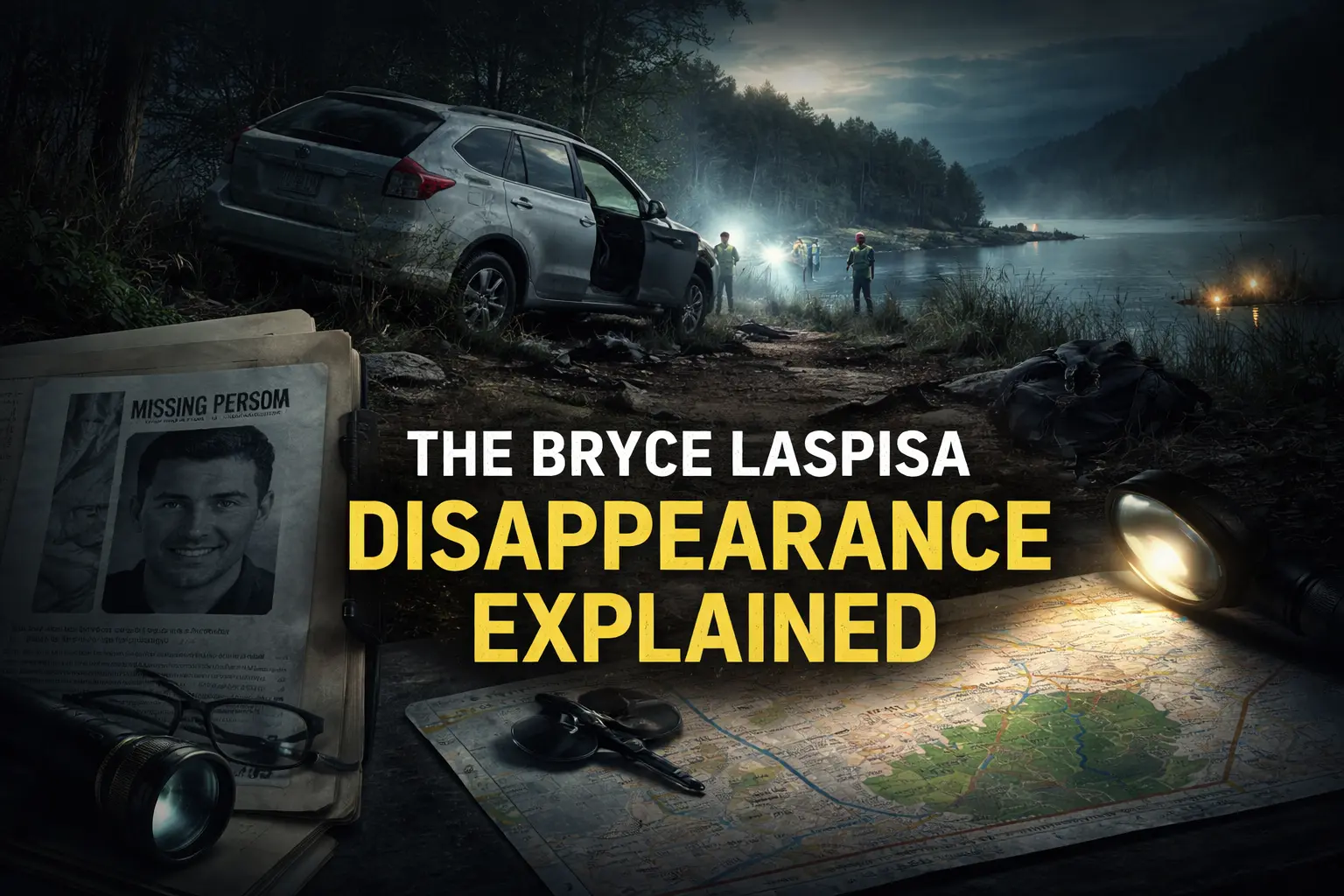
In the early morning hours of August 30, Bryce’s Toyota Highlander left Interstate 5 near Castaic Lake in Los Angeles County. The vehicle went down an embankment and crashed violently. Personal belongings were thrown from the car. The impact flipped the SUV.
When authorities arrived, Bryce was gone.
Investigators found blood inside the vehicle but concluded it likely came from a minor injury. There was no body at the scene. No clear footprints pointed to a direction of escape. His phone and wallet were missing, suggesting he left the wreck under his own power.
Search teams flooded the rugged terrain around Castaic Lake. Dogs, helicopters, and volunteers scoured the area. The landscape was steep and unforgiving.
Bryce was not found.
He disappeared within minutes of the crash.
Investigation and Evidence
The Bryce Laspisa investigation concentrated heavily on the crash site and surrounding wilderness. The terrain itself presented serious hazards: steep drops, thick brush, and water access. Early theories included the possibility that Bryce succumbed to injuries or environmental exposure.
But extensive searches produced no remains.
The lack of physical evidence has defined the case ever since. His belongings were scattered, yet there was no definitive trail showing where he went. Nearby surveillance footage failed to capture a confirmed sighting after the accident.
Investigators also examined Bryce’s behavior in the days leading up to the disappearance. Friends described emotional turmoil. Some public reports mentioned possible substance use, though these details remain disputed and have not been confirmed by official findings.
What cannot be disputed is the shift in behavior. Bryce isolated himself. He stalled his journey. And after surviving a crash that should have sent anyone to the hospital, he did not seek help.
From a law enforcement perspective, the case entered one of the most difficult categories: a missing adult, no confirmed crime scene, no suspect, and no body.
That combination limits investigative options almost immediately.
Suspect Analysis
There is no official suspect in Bryce Laspisa’s disappearance.
Authorities have never announced evidence proving foul play, but they have not ruled it out either. The crash location was remote yet accessible, leaving open the possibility that Bryce encountered another person after leaving the vehicle.
Public discussion typically revolves around three broad explanations:
- A psychological crisis leading to voluntary disappearance
- An accidental death in the surrounding wilderness
- An encounter with an unknown third party
Each theory leaves gaps.
A voluntary disappearance would require Bryce to survive without identification, confirmed income, or reliable sightings. An accidental death should have produced remains, given the scale of the search. A third-party encounter lacks forensic support.
No single explanation fits cleanly. The case sits in an uncomfortable middle ground where certainty refuses to form.
Trial or Current Status
No crime has been formally established, and therefore no trial has taken place. Bryce Laspisa remains listed as a missing person.
Law enforcement agencies continue to keep the case open. His family has maintained public advocacy, working to preserve awareness. Age-progressed images have been released in hopes that someone might recognize him.
Over the years, there have been reported sightings. None have been confirmed.
The file remains active.
Unanswered Questions
The Bryce Laspisa car crash timeline still raises questions investigators cannot resolve.
Why did he stay parked in Buttonwillow for so long?
What was happening internally during those hours of isolation?
Why continue south only to crash near Castaic Lake?
Why walk away from a survivable accident instead of calling for help?
Where did he go immediately afterward?
Even the central question — whether Bryce intended to disappear — remains unanswered.
His parents have publicly expressed their belief that Bryce may have been experiencing a mental health crisis. Without Bryce present to explain his state of mind, every theory is incomplete.
That absence is what keeps the case alive. It resists closure.
Social or Legal Impact
The Bryce Laspisa missing college student case has become part of a wider conversation about mental health awareness and recognizing behavioral warning signs.
In hindsight, many people analyze the phone conversations between Bryce and his parents during his stalled trip. They were in constant contact. They urged him home. They arranged roadside assistance. They took comfort in his reassurances.
Some observers later framed these moments as missed opportunities. Others point out how difficult it is to interpret distress from a distance, especially when a loved one insists they are fine.
The case underscores a painful truth: families often make decisions with incomplete information. There is no universal guide for identifying a psychological emergency unfolding over a phone call.
Online discussions about the unsolved Bryce Laspisa case details frequently shift toward education — encouraging awareness of crisis resources and emphasizing how subtle warning signs can be.
Reflective Conclusion
The Bryce Laspisa disappearance explained is a story without an ending.
A young man drove south. He paused. He crashed. He walked away.
Everything after that dissolves into uncertainty.
True crime stories often promise resolution — an arrest, a confession, a courtroom finale. This case offers none of that. Instead, it leaves a family suspended between hope and grief, and a public still trying to assemble meaning from fragments.
Bryce Laspisa is not a headline or a theory. He is a missing son. His absence continues to ripple through the lives of those who love him.
Until credible evidence surfaces, the case remains open, fragile, and unfinished.
And in that unfinished space, the same question continues to echo:
What happened to Bryce Laspisa?
No one has answered it yet.
FAQ
-
What is the Bryce Laspisa disappearance explained in simple terms?
The Bryce Laspisa disappearance explained refers to the 2013 case of a 19-year-old college student who drove from Northern California, stalled for hours during the trip, crashed near Castaic Lake, and vanished after walking away from the wreck. Despite large searches and ongoing investigation, Bryce has never been found, and no confirmed evidence explains where he went after the crash.
-
When and where was Bryce Laspisa last seen?
Bryce Laspisa was last known to be near Castaic Lake, California, in the early morning of August 30, 2013. His crashed vehicle was discovered off Interstate 5. The Bryce Laspisa disappearance explained timeline shows that he survived the accident and left the scene on foot, but no verified sightings have been confirmed afterward.
-
What happened before Bryce Laspisa disappeared?
Before his disappearance, Bryce had been driving from Sierra College toward his parents’ home. He spent many hours parked in Buttonwillow, California, speaking with his parents by phone. The Bryce Laspisa disappearance explained timeline documents unusual delays, emotional stress reported by friends, and roadside assistance helping him refuel before he continued driving south.
-
Did investigators find evidence of foul play?
Authorities have not publicly confirmed evidence of foul play in Bryce’s case. The Bryce Laspisa disappearance explained investigation focused on the crash site and surrounding terrain, but no clear forensic trail established what happened after he left the vehicle. His case remains classified as a missing person investigation.
-
Were large search efforts conducted after the crash?
Yes. Search teams used helicopters, dogs, and ground crews to comb the rugged area around Castaic Lake. Despite extensive efforts, Bryce was not located. The Bryce Laspisa disappearance explained remains one of the challenges investigators face when a person goes missing without a confirmed crime scene or physical trail.
-
Is the Bryce Laspisa case still open today?
Yes. Bryce Laspisa is still listed as a missing person, and the case remains open. Age-progressed images have been released, and authorities continue to accept tips. The Bryce Laspisa disappearance explained continues to draw public attention because there has been no confirmed resolution or verified sighting since 2013.